
The fastest way to spot a scam is to watch for two things happening together: someone pushing you to act immediately, and a request for unusual payment or personal information. If you notice urgency paired with a demand for gift cards, wire transfers, crypto, or your Social Security number, stop the conversation and verify independently before doing anything else.
TL;DR:
- Urgency paired with requests for gift cards, wire transfers, or cryptocurrency is a key sign of scam attempts that require immediate verification.
- Scammers often impersonate known organizations, send unsolicited messages, and request personal data or verification codes to catch victims off guard.
- Payment methods like gift cards and crypto are irreversible, making any legitimate request for these channels a clear red flag.
- Recognizing scam scripts involves looking for generic greetings, spelling errors, inconsistent details, and mismatched branding or email domains.
- Acting quickly by stopping responses, verifying independently, reporting at official portals, and involving trusted contacts minimizes financial and identity damage.
Table of Contents
- Top Scam Warning Signs You Should Never Ignore
- How to Verify a Suspicious Message Without Taking the Bait
- Why Gift Cards, Wire Transfers, and Crypto Are Red Flags
- Common Scam Scripts and Their Telltale Signs
- What to Do Right Now If You've Been Targeted
- How Scruteon Keeps You a Step Ahead
- Protecting Older Adults and Younger Users From Scams
- The Psychological Tricks Behind Every Scam Script
- New Scam Tactics Showing Up in 2026
- Reading Between the Lines of a Scam Message
- Get Ongoing Scam Alerts From Scruteon
- Where to Report Scams and Get Recovery Help
- Sources
- FAQ
Top Scam Warning Signs You Should Never Ignore
Most scams share a small set of ingredients, no matter what story wraps around them. Learn to spot these and you'll catch the con before it costs you anything.
- Urgency and pressure tactics. A caller or emailer insists you act in the next few minutes or hours, often threatening arrest, account closure, or a missed deadline. The FTC notes that legitimate companies and government agencies rarely demand instant action, and they never threaten to have you jailed over the phone.
- Requests for unusual payment methods. Gift cards, wire transfers, cryptocurrency, and payment apps come up constantly in scam scripts because they're hard to trace and nearly impossible to reverse.
- Unsolicited contact and impersonation. A message you didn't expect, from someone claiming to be your bank, the IRS, Amazon, or even a relative in trouble, is a signal to slow down. Scammers frequently spoof caller ID and email addresses to look official.
- Requests for personal information or verification codes. No legitimate business texts you asking for a one-time passcode, your full account number, or your password. If you get that request, the message is fraudulent.
- Offers that sound too good, paired with secrecy. Winning a sweepstakes you never entered, a "guaranteed" investment return, or a stranger's sudden romantic interest, especially when they ask you to keep it quiet, is a textbook setup.
The Consumer Financial Protection Bureau lists requests for money or personal data, pressure to act fast, and impersonation of known organizations as the three classic warning signs behind nearly every fraud complaint it tracks. Once you recognize the pattern, it shows up everywhere from text messages to phone calls to dating apps.
Pro Tip: Keep a mental checklist of just two questions: "Why do they need this right now?" and "Why this exact payment method?" Scammers rarely have good answers to either.
How to Verify a Suspicious Message Without Taking the Bait
Verification doesn't require special tools. It requires patience and a second source.
- Look up the company's phone number yourself, from a billing statement or the official website, rather than calling the number in the suspicious message.
- Inspect the sender's email address closely and hover over links before clicking; the FTC's phishing guidance recommends typing the company's web address directly into your browser instead of clicking anything.
- Run a reverse image search on a dating or social media profile photo. Stolen photos of models or military personnel are common in romance scams.
- Tell a friend, family member, or your bank before sending money or information. Scammers count on isolation, and a second opinion breaks that spell almost every time.
Organizations that verify credentials publicly, the way accredited institutions publish their accreditation status for anyone to check, give you an easy way to confirm legitimacy. Scammers never offer that kind of transparency.
Why Gift Cards, Wire Transfers, and Crypto Are Red Flags
Once money moves through these channels, it's essentially gone. Gift cards get drained the moment the code is read over the phone. Wire transfers clear in minutes with no built-in fraud protection. Cryptocurrency transactions are irreversible by design.
- Tech support scammers ask victims to buy gift cards to pay a fake "removal fee."
- Romance scammers request wire transfers for supposed medical emergencies or travel costs.
- Investment scammers push victims toward crypto exchanges, sometimes coaching them through the process step by step.
If you've already paid this way, contact the gift card issuer, your bank, or the wire service immediately, then Reportfraud. Speed matters more than anything else once money is moving.
Common Scam Scripts and Their Telltale Signs
Scams tend to follow recognizable templates. Once you've seen one version, the others get easier to spot.
- Phishing emails. Generic greetings like "Dear Customer," spoofed company domains, and links asking you to "verify your account" are the giveaways the FTC highlights. Real companies address you by name and don't email you to reset a password you didn't request.
- Tech support scams. A pop-up warns your computer is infected and provides a number to call. The person on the line asks you to install remote-access software, which hands them your entire system.
- Romance scams. Someone you met online declares love within days, then asks to move the conversation off the dating app. Money requests for flights, visas, or medical bills follow soon after, a pattern the FTC's romance scam guidance documents repeatedly. This pattern has also fueled a newer, more damaging version: the romance investment scam, sometimes called pig butchering, where the "partner" eventually convinces you to invest in a fake crypto platform that shows fabricated gains.
- Imposter and prize scams. A caller claims you owe back taxes, missed jury duty, or won a prize that requires an upfront "processing fee." Threats of arrest or account suspension almost always follow.
What to Do Right Now If You've Been Targeted
Acting fast limits the damage. Work through this in order.
- Stop responding to the scammer immediately and save screenshots, emails, and call logs as evidence.
- Contact your bank or payment provider and ask about reversing a transfer or freezing a card.
- File a report at ReportFraud.ftc.gov and, if personal information was exposed, start a recovery plan at Identitytheft, which walks victims through sample letters and account-recovery checklists.
- File a police report if you lost money, especially for larger amounts, since some banks and insurers require one before processing a claim.
The CFPB's own list of classic fraud warning signs exists precisely because these patterns repeat across millions of complaints every year. Documenting everything now makes every step afterward, from bank disputes to police reports, go faster.
How Scruteon Keeps You a Step Ahead
A free newsletter sends short emails regularly breaking down real scams in plain language, no tech background required. Each post explains the specific red flags behind a current scheme, whether it's a fake IRS call or a crypto investment pitch dressed up as a romance.
Not sure if something you received is legitimate? Scruteon's free advice page lets you ask directly. For deeper reading on specific scam types, the advance-fee scam breakdown and catfishing scam guide cover two of the patterns scammers reuse most often.
Protecting Older Adults and Younger Users From Scams
Older adults and young people get targeted differently, and the warning signs you teach them should match the scams they're actually likely to see.
Seniors are frequent targets for grandparent scams, where a caller claims to be a jailed grandchild needing bail money wired immediately, and for tech support scams that exploit unfamiliarity with pop-up warnings. The fix isn't a lecture. It's a standing rule: no family member ever asks for gift cards or wire transfers, full stop, and any call claiming otherwise gets verified by phoning another relative first. Posting the bank's real fraud hotline number next to the phone helps too, since scammers count on victims not knowing where else to turn.
Teens and young adults face a different set of traps: fake job offers that "overpay" and ask for a refund, social media giveaways that require sending crypto first, and romance scams that start on gaming platforms or social apps rather than dating sites. Because younger users often manage their own money without much oversight, the most useful habit is simple. Before sending anything to someone met only online, pause for 24 hours and ask a parent, older sibling, or friend to look at the conversation.
In both groups, the strongest protection is a household rule that nobody is embarrassed to ask, "Does this sound like a scam?", before money changes hands.
The Psychological Tricks Behind Every Scam Script
Every scam runs on the same three emotional levers: fear, greed, and social proof. Understanding them makes the manipulation obvious in real time.
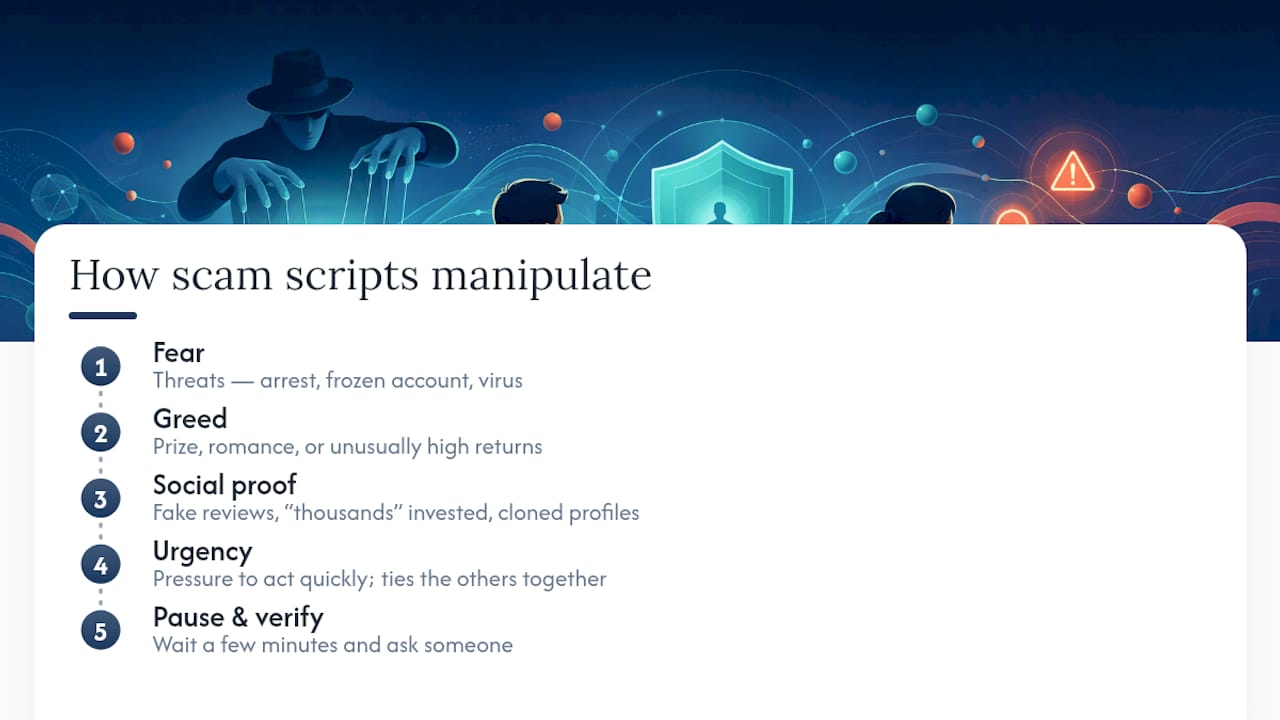
Fear shows up as threats: arrest, deportation, a frozen bank account, a virus destroying your files. It short-circuits careful thinking because the brain prioritizes escaping danger over analyzing details. Greed works the opposite direction, dangling a prize, a romantic partner, or an investment return that seems slightly too good, which quiets the skepticism that would normally kick in. Social proof adds a layer of false legitimacy: fake reviews, a scammer claiming "thousands of others already invested," or a cloned profile with real friends in the follower list.
Urgency ties all three together, and experts consistently point to it as the single most common manipulation tool scammers rely on. Pausing for even a few minutes and asking someone else to weigh in remains the fastest way to break the spell.
Scammers also work hard to isolate their targets, often coaching victims to keep the relationship or investment secret from family, or to lie if someone asks questions. That instruction to stay quiet is itself a red flag. Legitimate opportunities, relationships, and businesses never require secrecy from the people who care about you.
New Scam Tactics Showing Up in 2026
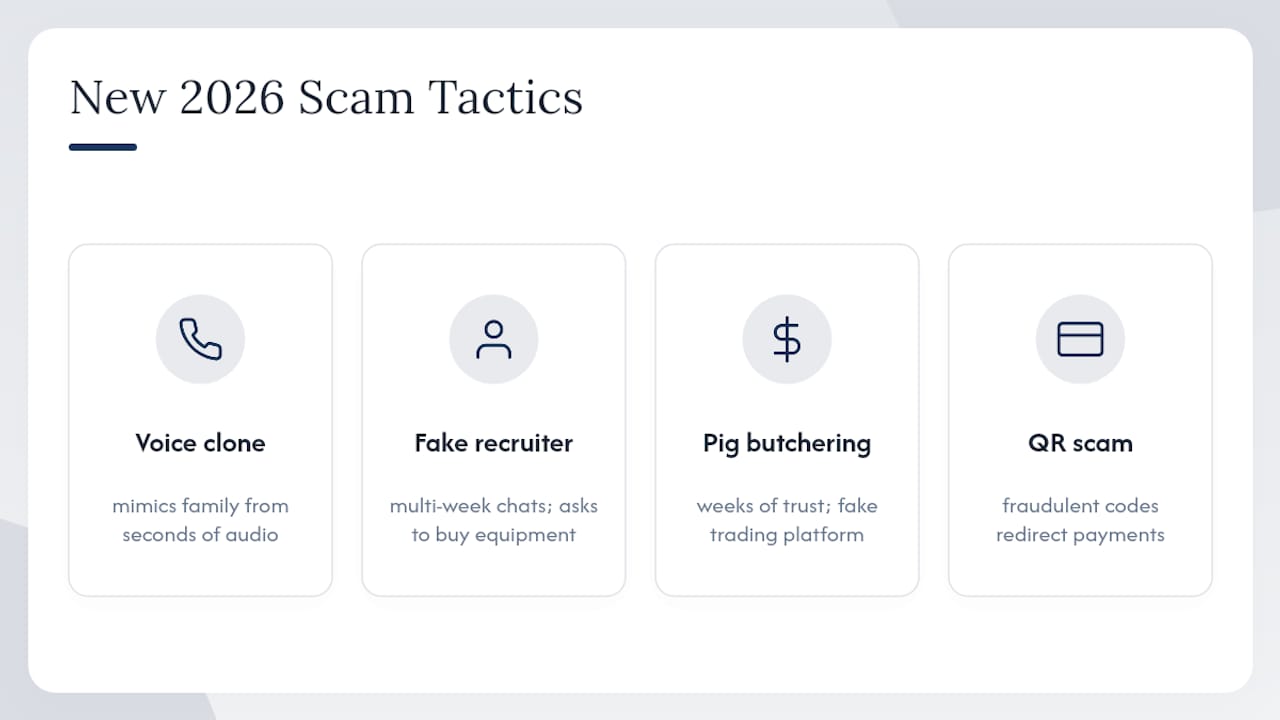
Scam scripts evolve as fast as the tools available to run them. Voice-cloning technology now lets criminals mimic a family member's voice convincingly enough to pull off a real-time version of the grandparent scam, using just a few seconds of audio pulled from social media. Fake job recruiters are running entire multi-week "interview" processes on messaging apps before asking new hires to buy equipment or forward a check.
The romance investment scam, widely known as pig butchering, has grown more elaborate. Scammers spend weeks or months building trust before introducing a fake trading platform, sometimes even letting victims withdraw a small amount early to build confidence before the real losses start. QR code scams have also spread, with fraudulent codes placed over parking meter stickers or sent by text, redirecting payment to the scammer's account instead of the intended service.
None of this changes the underlying pattern. Whether the contact comes through a cloned voice, a fake job portal, or a QR code, the same combination still applies: unexpected contact, pressure to move fast, and a request for money or credentials through a channel that's hard to trace or reverse.
Reading Between the Lines of a Scam Message
The words themselves often give a scam away before the request does. Watch for these patterns in how a message is written, not just what it asks for.
Generic greetings like "Dear valued customer" instead of your actual name are common in mass phishing campaigns, since the sender has your email but not your identity. Awkward grammar, unusual sentence structure, or phrasing that reads like a rough translation shows up frequently in scams run from overseas call centers. Inconsistent details across the same conversation, a caller who gets your name wrong, or a "bank representative" who doesn't know basic account details you'd expect them to have, are equally telling.
Mismatched formatting matters too: an email claiming to be from a major bank but using a generic Gmail address, or a text message with a link that doesn't match the company's actual domain. Legitimate organizations proofread their communications and maintain consistent branding across every channel. When something reads slightly off, that instinct is usually right.
Get Ongoing Scam Alerts From Scruteon
Reading one article helps you spot today's scams. Staying ahead of next month's version, the ones using cloned voices or new crypto platforms, takes ongoing coverage. A free newsletter sends short emails once or twice a week breaking down whatever scam is actively circulating, written so anyone can act on it in a few minutes.

If you're staring at a message right now and can't tell whether it's legitimate, submit it through Scruteon's free advice page and get a plain-language read on what to watch for. The service focuses on education and prevention. It doesn't investigate cases or work with law enforcement, so anything involving lost money still needs a report filed with your bank and the FTC. For everything else, sign up for the free newsletter and get the next warning before it reaches your inbox as an attack instead of an alert.
Where to Report Scams and Get Recovery Help
- Reportfraud: the FTC's main portal for reporting any consumer scam.
- Identitytheft: step-by-step recovery plans if personal data was exposed.
- Usa: a general directory of scam types and where to report each one.
This article is general information, not a substitute for advice from a qualified financial advisor. Consult a qualified financial professional about your own circumstances before acting on anything here.
Sources
- Sure ways to spot a scammer | Federal Trade Commission
- Reportfraud
- What are some classic warning signs of possible fraud and scams? | CFPB
- Identitytheft
FAQ
What Are Five Warning Signs of a Scam?
Pressure to act immediately, requests for gift cards or wire transfers, unsolicited contact from someone claiming to represent a known organization, requests for personal information or verification codes, and offers that seem too good combined with a request for secrecy.
How Do I Know If I'm Talking to a Scammer?
If the person contacted you unexpectedly, pressures you to decide quickly, and asks for money through gift cards, wire transfers, or crypto, you're very likely talking to a scammer. Verify by calling the organization back using a number you find independently, not one they gave you.
What Are the Biggest Red Flags of a Scammer?
Urgency and threats top the list, followed by requests for unusual payment methods and any instruction to keep the conversation secret from family or your bank. The FTC warns that no legitimate entity will ever tell you to transfer your money to "protect" it.
How Can I Check If a Message Is a Scam?
Look up the company's official number or website yourself instead of using contact details in the message, and check whether the email domain matches the real company's exactly. If you're still unsure, Scruteon's free advice page lets you ask directly before you respond to the sender.
Recommended
- Advance Fee Scam: How to Spot It and Stop It Cold
- Venmo Scams: Avoid a 30–75 Day Chargeback, U.S. Steps and Free Advice
- Catfishing Scams: How to Spot Them and Respond Fast
- What Is a Money Mule Scam and How Do You Avoid One?
The information in this AI-assisted-generated article is for educational purposes. Scam tactics change fast, and we cannot guarantee that this information is always complete or up to date.
By reading this article, you agree that Scruteon is not responsible for any financial losses, fraud, or damages that occur if you rely on this content. This is not professional financial or legal advice. If you suspect you are a victim of a scam, please contact your bank or local law enforcement immediately.