
A money mule is someone who receives and moves illegally obtained money on behalf of criminals, whether they know it’s dirty money or not. The channels vary: bank accounts, cashier’s checks, wire transfers, gift cards, cryptocurrency, and prepaid debit cards are all common ways criminals push stolen funds through a mule to make the trail disappear.
If someone you don’t know well has asked you to receive money and forward it, stop all contact right now and call your bank. Tell them what happened so they can flag or freeze the account before more damage is done.
Here’s the part people miss: you don’t have to know you’re laundering money to face consequences. Banks and investigators generally hold account holders responsible for what happens in their own accounts, knowingly or not.
Pro Tip: After you contact your bank, file a report at Ic3 the same day. Investigators move faster when the trail is fresh.
-
Stop responding to the person or company immediately
-
Call your bank’s fraud line before you do anything else
-
Report the incident to the FBI’s Internet Crime Complaint Center
-
Save every message, screenshot, and transaction record you have
During a single ten-week sweep in 2021, agencies coordinated action against roughly 4,750 suspected money mules nationwide. That’s not a fringe problem. That’s a pipeline criminals depend on every day.
Key Takeaways
Money mule scams work by exploiting trust and urgency to move stolen funds through a stranger’s bank account, and stopping contact immediately along with notifying your bank remains the single most effective defense.
| Point | Details |
|---|---|
| Definition matters | A money mule moves illegally obtained funds for someone else, knowingly or not, through bank transfers, gift cards, crypto, or checks. |
| Act immediately if targeted | Stop all contact, call your bank to freeze activity, then file a report at Ic3. |
| Watch for verification refusal | Recruiters who won’t video call or provide real business documents are showing you their scam. |
| Consequences hit unwitting mules too | Account holders can face charges, frozen accounts, and identity theft even without knowing the money was stolen. |
| Recovery takes multiple steps | Credit freezes, bank fraud teams, and IdentityTheft.gov resources work best when used together, not alone. |
Table of Contents
-
What Are the Warning Signs of a Money Mule Recruitment Attempt?
-
What Happens Legally and Financially if You’re Caught as a Money Mule?
-
How Can You Protect Yourself and Recover From a Money Mule Scam?
-
What Does a Money Mule Scam Cost Victims Beyond Fines and Charges?
-
How Do You Tell a Real Job Offer From a Mule Recruitment Scheme?
-
The Gap Between Official Warnings and What People Actually Do
How Do Criminals Recruit Money Mules?
Recruitment rarely looks like a crime in progress. It looks like an opportunity.
Job boards and social media are the biggest funnels. A “remote payment processor” listing promises easy commission for handling transfers. Dating app matches ask you to receive money “just this once” because their account is frozen overseas. Marketplace buyers overpay and ask you to wire back the difference. Someone posing as a government agent or courier says you owe a fee and need to move funds to clear it.
The scripts share a pattern: easy money, a small commission, a sob story, or a sweepstakes win that needs “processing.” Once you engage, the actual ask follows fast:
-
Receive a deposit and forward most of it elsewhere
-
Buy gift cards or crypto and hand over the codes or wallet address
-
Open a new bank account “for business purposes”
-
Let someone use your account temporarily “to help a friend”
Recruitment isn’t purely online, either. Offline recruiting happens through classroom contacts, gyms, and community groups, and it disproportionately targets teens and young adults who don’t yet recognize the setup.
What Are the Warning Signs of a Money Mule Recruitment Attempt?
A handful of quick checks can tell you almost everything you need to know before you respond to a suspicious offer.
-
The offer involves receiving or forwarding money for someone you’ve never met in person. That alone should stop you.
-
They push urgency. “This has to happen today” is a pressure tactic, not a business practice.
-
They ask for secrecy. Legitimate employers don’t ask you to hide the job from your bank or family.
-
They refuse a video call or won’t provide real business documents. Recruiters often deliberately dodge verification because it exposes them.
-
Payment involves gift cards, cryptocurrency, or cashier’s checks. These three show up constantly in mule schemes because they’re hard to trace and hard to reverse.
-
The messages have poor grammar or come from a vague, unverifiable company name. Recruiters use this as a filter. People who ask too many questions get dropped; people who don’t get roped in.
Pro Tip: Ask for a company’s registration number and a live video call before agreeing to anything. Scammers almost never comply with both, and that refusal is your answer.
What Happens Legally and Financially if You’re Caught as a Money Mule?
The consequences hit even if you had no idea you were laundering money.
Criminal exposure is real: money laundering and aiding fraud charges can apply whether you were a willing participant or a confused one. Prosecutors look at intent, but “I didn’t know” is not an automatic shield, especially if you ignored red flags or kept moving money after questions arose.
Beyond criminal risk, the financial fallout tends to hit fast:
-
Your bank can freeze or permanently close your account
-
You may end up on a shared industry blacklist that makes opening new accounts difficult for years
-
Sharing personal information to “set up” an account for someone else creates a direct identity theft risk
-
Civil liability can follow if victims pursue recovery through the courts
Coordinated federal action shows how seriously this is treated. In one recent sweep, agencies acted against nearly 4,750 people suspected of mule activity, and money-muling networks across Europe show a similarly stark pattern: over 90% of identified mule transactions trace back to some form of cybercrime.
How Do Banks and Investigators Catch Money Mule Activity?
Banks watch for patterns that don’t match how a normal account behaves. A steady stream of small deposits from unrelated senders, sudden large transfers to overseas accounts, or a personal account suddenly moving business-sized sums all trip internal fraud alerts. Cross-border routing that doesn’t match the account holder’s stated activity is another common flag.
If you suspect you’ve been pulled into a scheme, document everything before you do anything else:
-
Screenshot every message, including timestamps and usernames
-
Save transaction records showing amounts, dates, and sender details
-
Write down how the initial contact happened and what you were told
Then work through this order: contact your bank or payment provider first to secure your accounts, file a report with the FBI’s Internet Crime Complaint Center, and consider a local police report if money has already left your account.
-
Investigators may ask for your documentation and a timeline of events
-
Cooperate fully, but you’re allowed to have an attorney present for formal interviews
-
Being upfront about confusion or manipulation early tends to work in your favor
How Can You Protect Yourself and Recover From a Money Mule Scam?
Prevention and recovery both start with the same instinct: stop moving money the moment something feels off.
-
Cut contact immediately with anyone who asked you to receive or forward funds.
-
Call your bank and any payment app involved to freeze activity and dispute unauthorized transactions.
-
Change your passwords, especially if you shared login details or let someone remote into your device.
-
Close or replace compromised accounts rather than trying to “clean up” an account that’s already flagged.
-
Place a fraud alert or credit freeze with the major credit bureaus if you shared your Social Security number or ID.
-
Monitor your statements and credit reports for months afterward, not just the following week.
Prevention habits matter just as much: never give a stranger access to your accounts, verify any employer through an independent search rather than a link they send you, and treat any unsolicited request to move money as suspicious by default, no exceptions for how convincing it sounds.
Pro Tip: If a senior family member mentions a new “remote job” involving deposits and transfers, ask to see the job posting yourself. Elder-focused scams often rely on nobody double checking the details.
If real money has already left an account, a consumer attorney or your local Area Agency on Aging (for older victims) can help you understand recovery options beyond what a bank offers.
Why Scruteon Tracks Money Mule Tactics Closely
Recruitment scripts change fast. What worked last year gets tweaked, retested, and reused with a new cover story every few months, which is why static advice pages go stale.
Scruteon sends one or two short, plain-language alerts a week covering real scams as they’re happening, including romance scams, phishing, tech support fraud, and elder fraud tactics that often feed into money mule recruitment. No jargon, no filler, just what’s circulating and how to spot it.
A recruitment message that looked professional last spring can be recycled word for word months later with a new company name slapped on it. Recognizing the pattern matters more than memorizing any single example.
If you’ve received a message that feels off, ask Scruteon directly before you respond to it. For ongoing awareness, the free newsletter flags new recruitment patterns as they surface, and the full guide covers a wider range of scam types beyond mule recruitment.
What Do Real Money Mule Scam Cases Actually Look Like?
A college student sees a “package reshipping” job on a job board. The pay sounds reasonable for light work: receive electronics, repackage them, ship them to a new address. What’s actually happening is that criminals bought the items with stolen credit cards, and the student is now the last domestic link before the goods vanish overseas.

A retiree meets someone on a dating app who eventually asks for help. Their business account is “frozen” and they need a trusted person to receive a wire and send it back out, minus a “thank you” fee. The wire is stolen fraud proceeds, and the retiree’s account is now flagged for suspicious activity.
A small business owner gets a message from a “new remote employee” onboarding tool asking them to process payroll for a contractor who can’t access direct deposit yet. The owner sends money through their business account, not realizing they just laundered funds for a stranger who never worked there.
Each case looks different on the surface: a job, a relationship, a business request. Underneath, the mechanism is identical. Someone outside the criminal network provides the account and the trust needed to move money one more step away from its source, and that’s the entire point of recruiting a mule instead of doing it directly.
What Does a Money Mule Scam Cost Victims Beyond Fines and Charges?
The financial penalty is only part of the damage. Frozen or closed accounts can leave people locked out of paying rent or bills for weeks while banks sort out what happened, and getting a new account approved afterward can take months if you land on an industry-shared fraud list.
Identity theft often rides along with mule schemes, since setting up accounts “for someone else” frequently means handing over a Social Security number, a driver’s license photo, or banking credentials that later show up in unrelated fraud. Untangling that mess, disputing charges, filing police reports, and monitoring credit reports for a year or more, eats time most people don’t have to spare.
Then there’s the part rarely mentioned in official guidance: the emotional toll. Victims describe shame, especially those recruited through a romance scam or a job offer they were genuinely excited about. Many blame themselves for not catching red flags that, in hindsight, seem obvious. That shame keeps some people from reporting quickly, which only gives criminals more time to move funds further out of reach.
Family relationships strain too, particularly when an older relative is targeted and younger family members feel frustrated or dismissive rather than supportive during the recovery process.
How Do You Tell a Real Job Offer From a Mule Recruitment Scheme?
Legitimate employers follow a predictable pattern: a real job posting on a verifiable company site, an interview (often on video), a formal offer letter, and payroll processed through standard systems, not through your personal bank account moving money to strangers.
Fraudulent recruitment skips or fakes those steps. If a “job” never requires an actual interview, never verifies your identity through normal HR channels, and instead jumps straight to asking you to receive deposits or purchase gift cards, that’s not an unconventional employer. That’s the scheme itself.

A few checks separate the two quickly. Search the company name plus the word “scam” before responding to anything. Ask for a callback number tied to a verifiable business line, not just a personal cell number. Request a formal offer letter with a real business address. And treat any job that centers on “payment processing,” “reshipping,” or “money transfer agent” with extra scrutiny, since these titles show up constantly in mule recruitment specifically because they sound plausible.
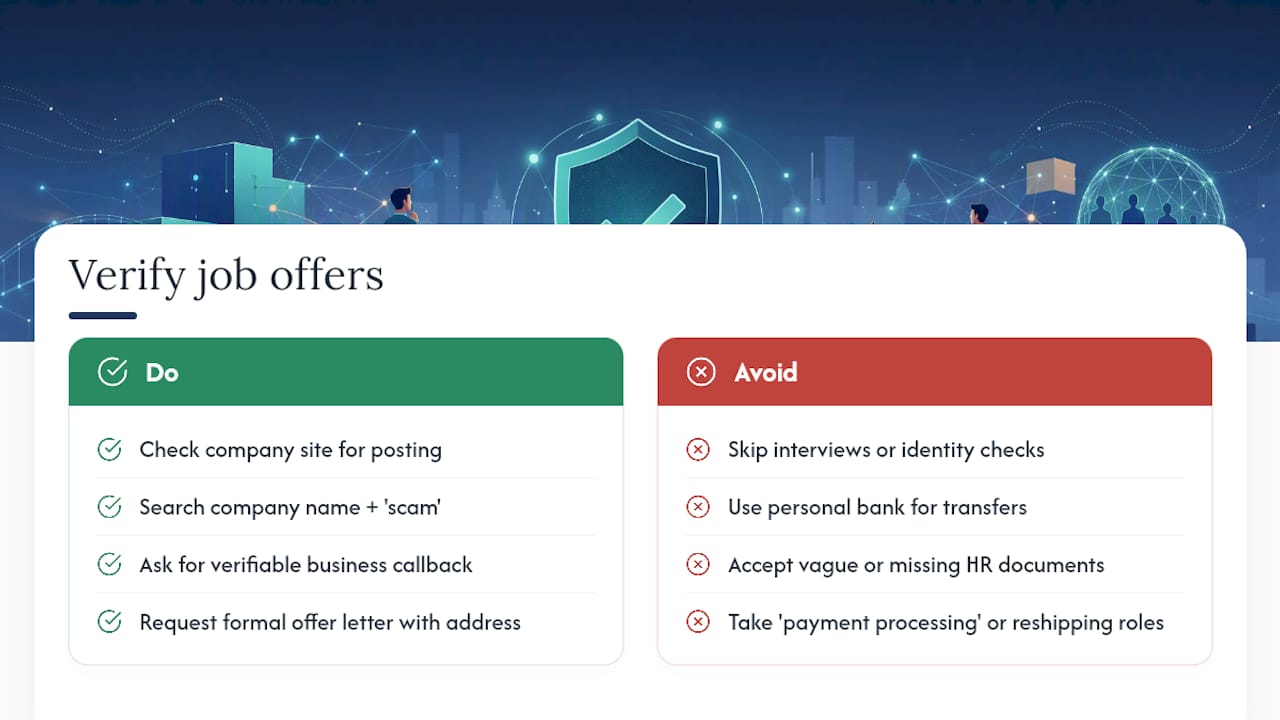
If a recruiter can’t or won’t provide standard hiring documentation, that refusal is the answer, not a gap you should fill in with trust.
What Recovery Resources Exist for Money Mule Scam Victims?
Recovery starts with containment, then moves into repair. Your bank can often reverse a transaction if you catch it fast enough, particularly with wire transfers flagged within hours rather than days. Once you’ve secured your accounts, shift focus to your credit and your identity.
Placing a fraud alert or a full credit freeze with the three major credit bureaus stops new accounts from opening in your name while you sort things out. If your Social Security number was shared, the FTC’s IdentityTheft.gov portal walks through a personalized recovery plan, including sample dispute letters and a tracker for each step you complete.
For the financial side, many banks have hardship or fraud resolution teams that can work through account closures without permanently damaging your standing, provided you report quickly and cooperate with their investigation. Nonprofit credit counseling services can help if the damage extends into overdue bills or collections tied to a frozen account.
If the case involves an older adult, Adult Protective Services and your state’s Area Agency on Aging can provide both practical support and a path toward involving law enforcement without the victim navigating it alone. None of these resources undo what happened overnight, but used together, they shorten how long the fallout actually lasts.
The Gap Between Official Warnings and What People Actually Do
Most money mule warnings assume the reader is naive or greedy. Neither is usually true. The people who get pulled in are often lonely, financially stressed, or simply trusting someone they believe they know, which is exactly why “just don’t fall for it” advice fails so often.
What the evidence actually supports is narrower and more useful: verification beats vigilance. Asking for a video call, a real business address, or a callback number does more to stop recruitment than any amount of general suspicion, because scammers are specifically built to slip past vague caution while failing concrete checks almost every time.
The bigger failure in conventional advice is treating this as a one-time literacy problem. Recruitment scripts evolve constantly, which means a single warning read once won’t hold up a year later. Ongoing exposure to current tactics, through something like a short weekly alert, does more long-term good than a one-off article ever will.
If there’s one priority, it’s this: build the habit of pausing before any money moves, and treat “verify first” as automatic rather than optional.
Frequently Asked Questions
What is a money mule, exactly? A money mule is a person who receives money obtained through fraud or theft and moves it to someone else, often through a bank account, wire transfer, or cryptocurrency wallet. Some know the money is stolen; many don’t realize it until their bank flags the account.
Can you get in trouble as a money mule if you didn’t know the money was stolen? Yes. Account holders are generally responsible for activity in their own accounts, so a lack of knowledge doesn’t automatically prevent criminal charges or account penalties, though it can affect how a case is prosecuted.
How do I know if a job offer is a money mule recruitment attempt? Watch for jobs centered on “payment processing,” reshipping packages, or transferring money for a company that won’t provide a real address, won’t do a video interview, or pressures you to move fast.
What should I do first if I think I’ve already sent money as a mule? Stop all contact with the person or company right away, call your bank to secure your accounts, and file a report with the FBI’s Internet Crime Complaint Center the same day.
Are seniors more targeted by money mule scams? Seniors are frequently targeted through romance scams and impersonation schemes, while students and jobseekers are more often targeted through fake employment offers, though both groups face real risk from either angle.
Where can I report a suspected money mule scam? Report to your bank or payment provider first, then file a complaint with IC3.gov, and consider filing a report with local police if funds have already been transferred.
The information in this article is for educational purposes only. Scam tactics change fast, and we cannot guarantee that this information is always complete or up to date.
By reading this article, you agree that Scruteon is not responsible for any financial losses, fraud, or damages that occur if you rely on this content. This is not professional financial or legal advice. If you suspect you are a victim of a scam, please contact your bank or local law enforcement immediately.
This article is general information, not a substitute for advice from a qualified lawyer. Consult a qualified legal professional about your own circumstances before acting on anything here.