
Catfishing scams are fake online identities built to earn your trust and then drain your bank account, your photos, or your peace of mind. If you suspect one, the sequence matters: stop responding, save every message and payment record, and never send money or gift cards to fix the problem.
Many people who report romance scams to the FTC say they lost money to someone they met on social media or a dating app, and the requests almost always escalate from small favors to large transfers.
-
Stop all contact and don’t explain why
-
Screenshot the profile, messages, and any payment requests before blocking
-
Report the account to the platform, then to the FTC, and IC3
Key Takeaways
Catfishing scams work by building emotional trust through a fabricated identity, and stopping them requires fast verification, refusal to send money, and immediate reporting to official channels.
| Point | Details |
|---|---|
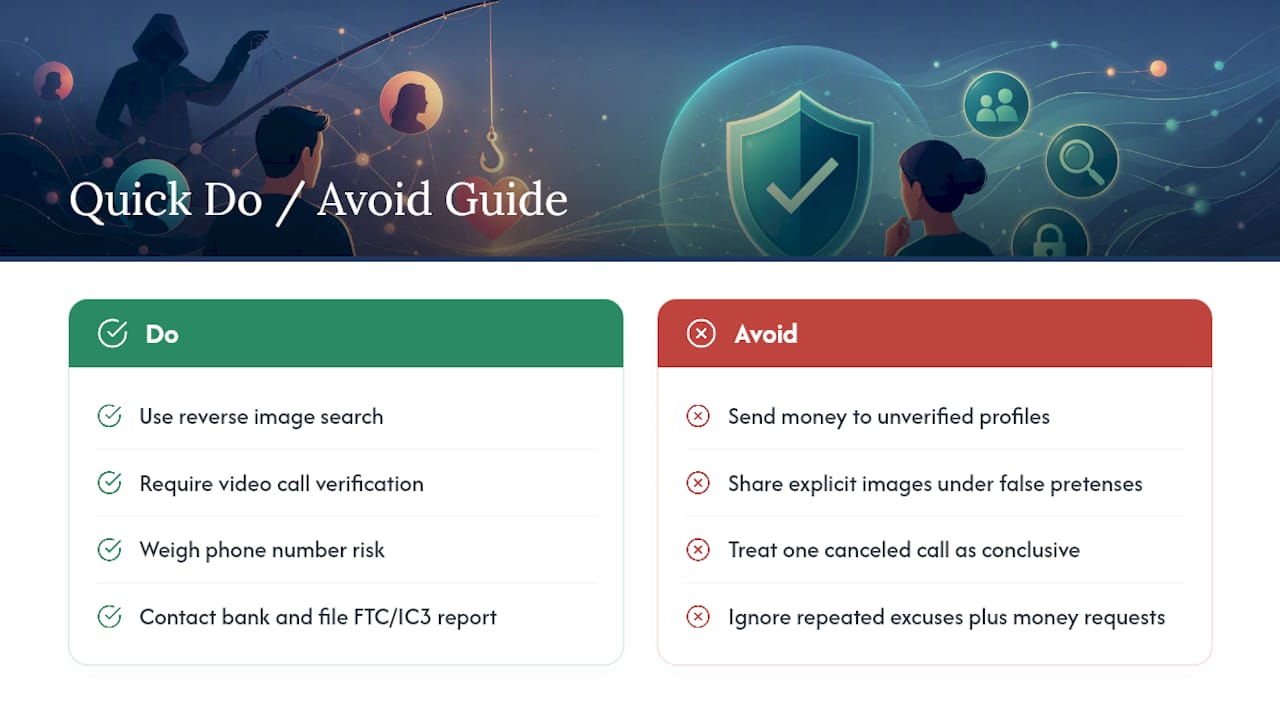
| Verify before trusting | Ask for a spontaneous live video call and run a reverse image search on their photos. |
| Watch the money request | Never send cash, gift cards, or crypto to someone you haven’t met in person. |
| Off-platform pressure is a signal | Requests to move to WhatsApp or Telegram early often help scammers avoid detection. |
| Preserve evidence immediately | Screenshot messages and payment records before blocking a suspected scammer. |
| Report through official channels | File with the FTC, IC3, and your bank without delay. |
Table of Contents
-
What Are Catfishing Scams, and When Do They Cross Into Fraud?
-
Catfishing Warning Signs: A Checklist Before You Trust Someone Online
-
Common Catfishing Scam Scripts You’ll Recognize Once You Know Them
What Are Catfishing Scams, and When Do They Cross Into Fraud?
Catfishing is the use of a fabricated online identity, often built from stolen photos, a fake name, and an invented backstory, to interact with someone who has no idea the person doesn’t exist. Not every catfish is a criminal. Some people build fake profiles out of insecurity or curiosity and never ask for anything. The line into criminal fraud gets crossed the moment that fake identity is used to extract money, explicit images, or personal information under false pretenses.
The photos themselves are usually the first giveaway if you know what to look for. Older catfishing operations relied on lifted images from real people’s social media, often models, service members, or aid workers whose faces get recycled across hundreds of fake profiles. Newer schemes increasingly use AI-generated faces that pass a casual glance but show up as synthetic in a reverse image search. The FBI treats these operations as romance scams once money or intimate content changes hands, and cases involving threats, blackmail, or stolen identity documents can escalate into sextortion or identity theft charges.
Catfishing becomes a prosecutable scam the moment a fabricated identity is used to defraud, harass, or steal from a real person, according to FTC consumer protection guidance.
Catfishing Warning Signs: A Checklist Before You Trust Someone Online
Most catfishing scams follow a script. The details change, but the pattern rarely does, which is exactly why a checklist works better than gut instinct.
-
Love bombing early on. Intense affection, “I’ve never felt this way before” messages, and talk of a future together within days of meeting online. This is a documented manipulation tactic used to fast-track emotional dependency before skepticism kicks in.
-
No video calls, ever. Every excuse sounds reasonable on its own (bad camera, spotty internet, shy about appearance) but stacked together they’re a pattern, not bad luck.
-
Pressure to move off the dating app or platform. A request to switch to WhatsApp, Telegram, or personal email within the first few conversations lets scammers dodge the platform’s fraud detection and keep the conversation somewhere harder to trace.
-
Inconsistent personal details. A birthday that shifts, a job title that changes, a hometown that doesn’t match the accent or timezone in their messages.
-
A thin or brand-new social media presence. Few friends, few photos, an account created weeks ago, or a follower list that looks bought rather than built.
-
Requests for money, gift cards, or crypto. Especially payment methods that can’t be reversed or traced, which is precisely why scammers prefer them.
-
Requests for explicit photos or video. Once sent, these can be used for sextortion, threats to share images with your contacts unless you pay.
Photos lifted from real people are common enough that a reverse image search through Google Images or TinEye should be routine, not paranoid, for anyone you’ve only met online.
Pro Tip: Run a reverse image search on the very first photo someone sends you, before you invest any emotional energy. It takes thirty seconds and catches a surprising share of fakes immediately.
Common Catfishing Scam Scripts You’ll Recognize Once You Know Them
Scammers reuse the same handful of storylines because they work. Recognizing the script often matters more than spotting any single red flag.
-
The medical emergency abroad. A sudden hospital bill, a stranded relative, a surgery that “insurance won’t cover,” always urgent, always solvable with a wire transfer.
-
The deployed service member or offshore worker. Military deployment or an oil-rig job explains why video calls are impossible and why they can’t meet in person for months.
-
The crypto “investment opportunity.” After weeks of relationship-building, the conversation shifts to a trading platform where your new partner promises to grow your money together, a scheme security researchers call “pig butchering.”
-
Sextortion and grooming. Explicit images are requested, then used as leverage for cash payments under threat of exposure.
-
Industrialized fraud rings vs. lone opportunists. Some catfishing operations run dozens of fake profiles from call centers with scripts and quotas; others are a single person testing whether it works. Both use nearly identical opening moves.
Scammers frequently target people going through a recent loss, divorce, or health scare, moments when loneliness lowers normal skepticism.
How to Verify Someone You Met Online, Step by Step
Verification doesn’t require confrontation. Most of these checks can happen casually, without tipping anyone off that you’re suspicious.
-
Ask for a live video call with a real-time request. Ask them to wave, hold up three fingers, or say today’s date on camera. A recorded loop or deepfake struggles with spontaneous, unscripted prompts.
-
Run a reverse image search on multiple photos, not just the profile picture. TinEye and Google Images both work; a match to a stock photo site, a model’s portfolio, or someone else’s Instagram is your answer.
-
Check for a cross-platform footprint. A real person usually has a LinkedIn, tagged photos from friends, and a history that predates last month. Zero digital shadow is a signal.
-
Ask a specific, time-anchored question. “What’s the weather like there right now?” or “What time zone are you in?” and compare the answer against what they’ve already told you.
-
Watch for video call glitches that suggest deepfake software, like unnatural blinking, a face that doesn’t quite match the lighting, or lips that lag slightly behind the audio.
Pro Tip: Ask to see their face turn sideways on a video call. Real-time deepfake tools still struggle with profile angles, and a sudden “bad connection” right after you ask is worth noting.
What to Do If You’ve Already Been Targeted or Scammed
Move fast, and move in this order.
-
Stop all contact and block the account immediately. Don’t send a farewell message explaining why; scammers use continued engagement to keep working you.
-
Preserve everything. Screenshot conversations, save payment confirmations, and note usernames, phone numbers, or wallet addresses before the account disappears.
-
Contact your bank or payment provider right away. Wire transfers and gift cards are nearly impossible to recover, but the faster you report a card charge or crypto transfer, the better your odds.
-
Report the profile to the platform where it happened, most dating apps and social networks have a dedicated fraud reporting flow.
-
Contact local law enforcement if you’ve lost a significant amount, received threats, or the scammer has personal documents or explicit images of you.
-
Reach out to the FBI directly when the fraud crosses state or national lines, involves large sums, or includes extortion threats.
A large share of romance scam victims never recover the money they send, which is exactly why speed on the reporting side matters more than a perfect case file. Emotional fallout is real too. Working through the shame and grief afterward with a therapist or counselor, such as the support outlined for recovering from a toxic relationship, often speeds recovery more than trying to handle it alone.
Prevention Habits That Actually Cut Your Risk
Most successful catfishing scams rely on the victim skipping a basic check, not on some unbeatable technique. A few habits close most of that gap.
-
Lock down your privacy settings and limit how much personal detail (workplace, city, routine, family names) is visible to strangers browsing your profile.
-
Never send money, gift cards, or crypto to anyone you haven’t met in person, no matter how convincing the emergency sounds.
-
Ask for verification before things get emotionally serious, not after you’re already attached to the story.
-
Slow down deliberately. Scammers rely on urgency; a relationship that can’t survive a two-week pause to “just get to know each other” was never stable to begin with.
-
Loop in a friend or family member to sanity-check the relationship from the outside, they’ll often spot inconsistencies you’re too invested to see.
-
Use two-factor authentication and strong, unique passwords on your dating and social accounts so scammers can’t hijack a real profile to run their scheme.
Pro Tip: Tell one trusted person about any new online relationship within the first week. Saying the details out loud to someone outside the situation is often the fastest way to catch what you’ve been rationalizing.
Why Trust This Guide
Scruteon runs a free newsletter that breaks down real, current scams, including romance and catfishing schemes, into plain-language alerts sent once or twice a week. The goal is simple: help everyday internet users, whether that’s a grandparent new to smartphones or a busy professional swiping between meetings, spot a scam before it costs them anything.
-
Scruteon tracks emerging scam patterns and turns them into short, readable alerts
-
Readers can submit a suspicious profile or message through Scruteon’s free advice service and get a personal read on whether it looks like fraud
-
The weekly newsletter covers romance scams alongside phishing, tech support fraud, and elder fraud
The Emotional Toll of Catfishing, and How to Recover
The financial loss from a catfishing scam is often the smaller wound. Victims frequently describe grief that mirrors an actual breakup, layered with the shame of having been fooled, which keeps many people from telling friends, family, or even police for weeks or months.

That silence makes things worse. Isolation is exactly what let the scam work in the first place, and staying quiet afterward just extends it. Talking to someone, a trusted friend, a support group for fraud victims, or a licensed therapist, helps separate the fact that you were deceived from any sense that you were foolish or gullible. Recovery tends to go faster when people process the loss the way they would any other relationship ending, with the added step of reporting the crime rather than absorbing it silently.
Some victims also experience lingering anxiety about online interactions generally, second-guessing every new contact for months. That caution fades with time and with a few successful, verified interactions. It doesn’t mean you’re broken; it means your instincts are recalibrating after being deliberately exploited.
How Catfishing Scams Differ From Other Online Fraud
Catfishing is a delivery mechanism, not the crime itself. The fake identity is the tool; the actual harm lands as one of several distinct crimes depending on what the scammer asks for.
Phishing tricks you into clicking a malicious link or handing over login credentials, usually through fear or urgency (“your account has been suspended”). Catfishing works the opposite way, through patience and affection built over weeks. Tech support scams impersonate a company or authority figure and rely on technical intimidation. Catfishing relies on emotional intimacy instead, which is why it can extract far more money over a longer period. Investment and crypto scams sometimes overlap with catfishing directly, the “pig butchering” pattern mentioned earlier starts as a romance and ends as a fake trading platform. The common thread across all of it is a manufactured relationship used as leverage, which makes catfishing harder to detect than a suspicious email precisely because it doesn’t feel like a transaction until money is already gone.
Who Catfishing Scams Actually Target
Romance and catfishing scams don’t discriminate neatly by age or income, but patterns show up. Adults over 50 report disproportionately large financial losses, often because they have more savings and, in some cases, less familiarity with reverse image searches or video call red flags. Younger adults on dating apps report catfishing more frequently in terms of raw incidents, though usually with smaller dollar amounts, sextortion and manipulation rather than large wire transfers.
Recently divorced, widowed, or otherwise isolated individuals show up repeatedly in case patterns, which tracks with scammers deliberately targeting people going through a life transition when loneliness is highest and scrutiny is lowest. Military-themed catfishing profiles specifically target women in their 40s through 60s, exploiting a cultural respect for service members that makes the “deployed and can’t video chat” excuse feel more plausible than it should.
Reported cases likely represent a fraction of what’s actually happening. Shame keeps many victims from filing anything, which means the scale of catfishing scams is almost certainly larger than official numbers suggest.
How Investigators Build a Catfishing Case
Catfishing cases are notoriously hard to prosecute, which is exactly why documentation on your end matters so much. Investigators typically start with the digital trail: IP addresses tied to the fake profile, the payment rails used (wire transfer services, gift card codes, crypto wallet addresses), and any phone numbers or email addresses linked to the account.
Cross-border cases, common since many catfishing operations run from overseas call centers, add jurisdictional complexity that can slow or stall prosecution entirely. That’s part of why the FBI and IC3 exist as centralized intake points: a single victim’s $3,000 loss might look small, but IC3 aggregates reports to identify patterns tied to the same wallet address or phone number across hundreds of victims, which is often what turns an isolated complaint into an actual federal case. Screenshots, payment confirmations, and saved messages you preserve at the moment you suspect fraud become the evidence that makes a prosecutable pattern visible.
What This Guide Gets Right That Most Advice Doesn’t
Most catfishing advice fixates on spotting a bad photo or a too-perfect profile. That’s useful but incomplete. The scams that actually succeed rely less on sloppy fakery and more on patience, weeks of steady, believable conversation that lowers your guard before any request for money shows up. Treating verification as a one-time check misses that entirely.
The bigger gap in conventional advice is timing. Most guides tell you what to do after you’ve already lost money. The higher-leverage move is verifying identity in the first two weeks, before emotional investment clouds judgment, not after a “medical emergency” appears. A single unscripted video call request early on does more to protect you than any red-flag checklist reviewed after the fact.
If you take one thing from this: slow down the relationship on purpose, and treat a refusal to verify as the answer itself, not a hurdle to work around.
Frequently Asked Questions
What exactly counts as a catfishing scam versus regular catfishing? Catfishing becomes a scam the moment the fake identity is used to ask for money, explicit images, or personal information under false pretenses. Harmless catfishing, someone lying about their appearance with no financial motive, is deceptive but not necessarily a prosecutable fraud.
How can I tell if a photo was AI-generated rather than stolen from a real person? AI-generated faces often show subtle inconsistencies in ears, hands, or background details, and they won’t return matches in a reverse image search the way a stolen real photo will. If a search returns nothing at all despite a seemingly normal photo, that’s itself a flag worth noting.
Is it safe to give someone my phone number if I haven’t met them in person? A phone number alone is relatively low risk compared to financial details, but scammers sometimes use it for spoofing or to build a cross-platform presence that looks more credible. Weigh it against how many other verification steps, like a video call, they’ve already passed.
What should I do if I already sent money to a suspected catfish? Contact your bank or payment provider immediately to ask about reversing the transaction, then report the case to the FTC and IC3. Speed matters far more than a perfect report, file first, refine details later.
Can catfishing scammers be prosecuted if they’re overseas? Yes, though it’s harder and slower. Agencies like the FBI and IC3 aggregate reports across victims to build patterns strong enough to pursue internationally, which is exactly why filing a report matters even if you doubt anything will happen to your specific case.
How do I know if I’m overreacting versus genuinely dealing with a catfish? Trust the pattern, not any single moment. One canceled video call means little; five excuses over three weeks combined with a request for money is a pattern worth acting on. If you’re unsure, Scruteon’s free advice service can help you sanity-check a specific situation without judgment.
This article is general information, not a substitute for advice from a qualified financial advisor. Consult a qualified financial professional about your own circumstances before acting on anything here.
The information in this article is for educational purposes only. Scam tactics change fast, and we cannot guarantee that this information is always complete or up to date.