
If a stranger’s payment lands in your Venmo account or someone pressures you for a code, stop and use Venmo’s in-app tools instead of your own judgment. Never send a separate refund to a stranger, no matter how convincing the story. Verify anything unusual through the Venmo Help Center or the FTC, and if you’re still unsure, Scruteon’s free advice service will tell you straight.
TL;DR:
Always verify unusual payments or requests through official Venmo channels and avoid sending refunds to unverified strangers.
Be aware that impersonation, accidental payment, phishing, romance, and overpayment scams follow predictable scripts that rely on social pressure and urgency.
Immediately stop communication and use Venmo’s built-in refund or decline options if you suspect a scam, and document everything with screenshots.
Setting account privacy, disabling discoverability, turning on multifactor authentication, and only paying verified profiles significantly reduce scam risks.
Chargeback investigations can take up to 75 days, and voluntary refunds to strangers carry the highest risk of permanent loss and account penalties.
Table of Contents
Common Venmo Scams and the Red Flags That Give Them Away
Most Venmo scams recycle the same handful of scripts. Once you can name the pattern, spotting it gets a lot easier.
-
Impersonation scams. Someone poses as Venmo support, a bank rep, or even a friend whose account got hacked. Red flag: they contact you first, and they ask you to “verify” your account by sharing a code.
-
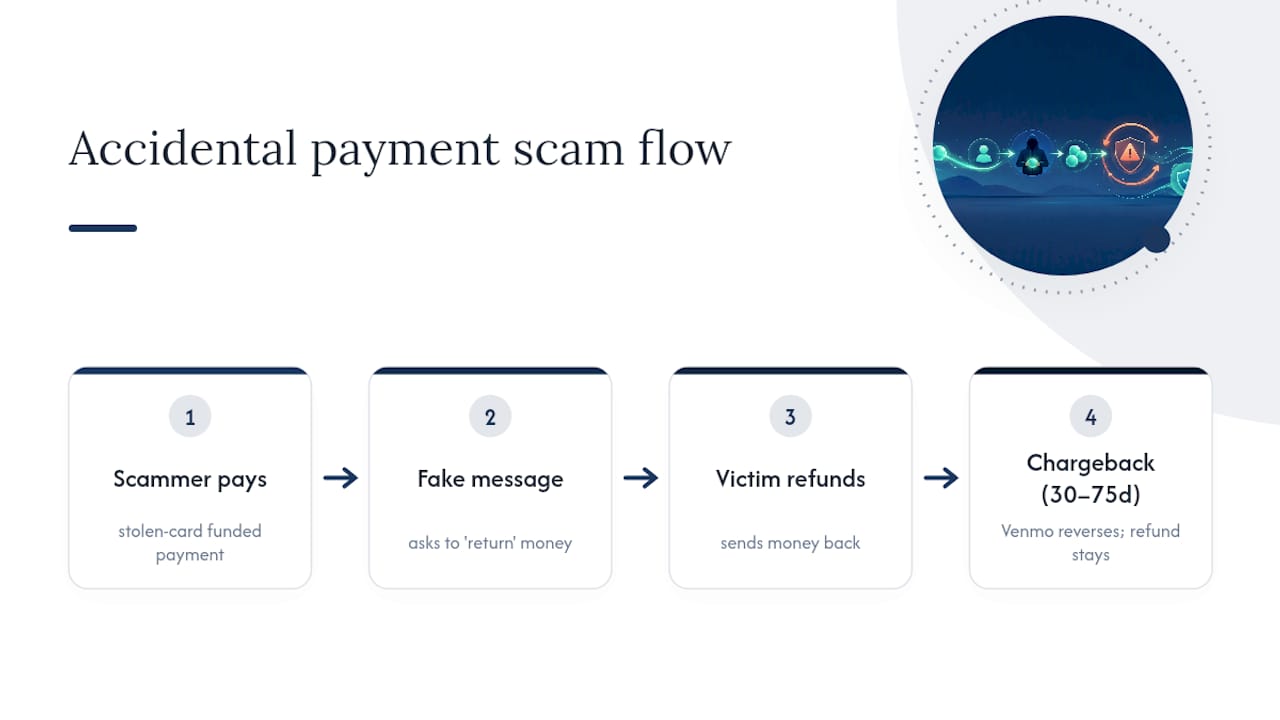
Accidental payment scams. A stranger sends you money, then messages asking you to send it back because it was “a mistake.” Red flag: the request to refund comes through chat, not through Venmo’s official refund button.
-
Phishing attempts. You get a text or email that looks like it’s from Venmo, asking you to log in through a link. Red flag: the URL doesn’t end in venmo.com, or the message creates urgency (“your account will be suspended”).
-
Buying and selling scams. A “buyer” sends a payment for an item, then claims it was sent by mistake or asks you to ship before the payment clears. Red flag: a buyer who insists on Venmo instead of a marketplace’s built in checkout.
-
Romance scams. A new online partner you’ve never met in person asks for money for an emergency, travel, or a shared investment. Red flag: they avoid video calls and pressure you to act fast.
-
Paper check and overpayment scams. Someone pays you with a check for more than the agreed amount and asks you to Venmo back the difference. Red flag: the check hasn’t cleared yet, but they’re already asking for cash.
If someone asks for your multifactor authentication code over the phone, hang up and check your account activity yourself. Venmo will never call and ask for that code, full stop.
Why Venmo Scams Work: The Mechanics Behind the Money Loss
The accidental payment scam is the one that trips up the most people, and it works because it exploits a normal human instinct: returning money that isn’t yours.
Here’s the sequence. A scammer funds a Venmo payment to you using a stolen credit card, then messages you claiming it was sent by mistake and asks you to send the amount back. You do, because it feels like the right thing to do. Weeks later, the real cardholder disputes the original charge, and Venmo reverses it. Your “refund” to the scammer is a separate transaction that doesn’t get automatically undone when that happens. You’re out the money twice.
Consumer reporting on payment app fraud documents a second common thread: caller ID spoofing. Scammers fake a number that looks like Venmo’s real support line, then walk victims through “verifying” their account by reading back an MFA code, which the scammer uses to log in elsewhere. Others send doctored screenshots claiming a payment already went through, pressuring a seller to ship an item before checking their own balance.
Dispute investigations tied to these scams routinely stretch toward the 30 to 75 day range Venmo cites for chargebacks, which means the financial hit often arrives long after the scammer has vanished.
What to Do if You’re Targeted by a Venmo Scam
Speed and documentation matter more than anything else once you suspect a scam. Work through this in order.
-
Stop talking to the sender. Don’t explain yourself, don’t negotiate, and don’t send anything back through a private transfer.
-
Use Venmo’s built-in decline or refund option on the original payment instead of sending a new one. This keeps the transaction reversible on Venmo’s end rather than creating a second, unprotected transfer.
-
Contact Venmo Support directly through the app and save screenshots of the conversation, the payment, and any transaction IDs before the sender can delete their account.
-
Call your bank or card issuer if you shared any financial details or if a linked card was used without your permission.
-
File a report with the FTC and, for extortion, threats, or losses running into the thousands, the FBI’s IC3.
-
Keep your documentation organized in case Venmo asks for evidence during a chargeback dispute.
Pro Tip: Export your Venmo transaction history as a CSV before you delete or archive anything. Timestamps and transaction IDs disappear fast once a scammer closes their account, and Venmo Support will ask for both.
Locking Down Your Venmo Account Before a Scam Happens
Most of the damage from Venmo scams is preventable with a handful of settings changes and daily habits.
-
Set your transaction visibility to private. Public payment feeds hand scammers a roadmap of who you pay and how often.
-
Turn off profile discoverability so strangers can’t find your account by phone number or email.
-
Use “Goods and Services” or pay verified business profiles for anything you’re buying, since personal payments carry none of the same protections.
-
Turn on multifactor authentication and use a password manager so your Venmo password isn’t recycled from your email account.
-
Restrict payments to people you actually know in real life, and verify any unfamiliar request through a text or call on a separate channel before sending money, a habit security researchers consistently point to as the single most effective defense.
-
Set up bank alerts so you know within minutes if a linked card gets charged somewhere unexpected.
Pro Tip: If a buyer’s payment shows as funded by a credit card rather than a bank transfer, treat the sale as higher risk. Card-funded payments are the ones most likely to get reversed weeks later.
How Long Do Venmo Chargebacks Take, and What’s at Stake?
A voluntary refund to a stranger is one of the costliest mistakes on Venmo because it can’t be pulled back once the original payment that funded it gets disputed and reversed.
| Stage | Typical timeframe | What happens |
|---|---|---|
| Chargeback investigation | About 30 days | Venmo works with the card issuer to review the dispute |
| Final decision | Up to 75 days | Venmo determines whether the original payment is reversed |
| If reversed | Immediate | Your account can show a negative balance and face temporary suspension |
Purchase Protection only applies to qualifying purchases made through eligible business or charity profiles. Personal payments between friends, family, or strangers don’t carry that same coverage, which is exactly why the “accidental payment” trap is so effective against everyday users.
Why Procedural Habits Beat Instinct Every Time
The instinct to help a stranger who claims they made a mistake is exactly what scammers count on, and it’s the reason Venmo scams keep working even as awareness grows. Scruteon publishes 1 to 2 posts a week breaking down exactly these patterns, because the fix isn’t more suspicion in general. It’s a specific habit: verify first, refund through the app, never through a private transfer.
What we’ve found covering scam reports is that the accounts that get burned aren’t the ones being careless. They’re the ones reacting to social pressure in the moment, whether that’s a “friend” in a hurry or a buyer threatening a bad review. Venmo’s social feed makes this worse by turning payment history into a trust signal scammers can study and mimic. A quick pause and a check through Scruteon’s free advice service costs nothing and beats guessing every time.
— Winston
Get a Second Opinion Before You Send Another Payment
Scruteon gives you something most banks and apps don’t: a free, no-pressure way to ask “is this a scam?” before you act, not after you’ve already lost the money. The newsletter breaks down real scams as they’re happening, in plain language, twice a week at most, so you’re never stuck decoding jargon while a scammer waits on the other end of a chat.
If a payment or message feels off, don’t sit with the uncertainty. Send it to Scruteon’s free advice service and get a straight answer on whether it’s legitimate. Want the pattern recognition built in ahead of time? Sign up for Scruteon’s free scam prevention guide and start spotting these scripts before they reach your inbox.
The information in this article is for educational purposes only. Scam tactics change fast, and we cannot guarantee that this information is always complete or up to date.