
An advance fee scam works one way: someone promises you a large payout, then asks for a smaller payment upfront to “release” it. The money never comes. If you’re reading this because someone just asked you to wire cash, buy gift cards, or send crypto before you can collect a prize, inheritance, loan, or job, stop replying and do not send anything else.
That’s the whole mechanism. Every version, from the email claiming to be a Nigerian prince to a fake employer asking for “training fees,” runs on the same trick: pay a little now, get a lot later. The “later” part never happens.
Here’s what to do right now, before you do anything else:
-
Stop all contact. Don’t reply, don’t explain, don’t ask questions.
-
Don’t send more money, even if you already sent some and they’re promising it back.
-
Save everything: screenshots, emails, texts, and payment confirmations.
Key Takeaways
Advance fee scams succeed by demanding payment before a promised payout, using irreversible transfer methods and manufactured urgency to prevent victims from verifying the offer independently.
| Point | Details |
|---|---|
| Core mechanism | Any request for payment before a bigger promised sum is the defining trait, regardless of the cover story. |
| Payment method is the tell | Requests for wire transfer, crypto, or gift cards from an unsolicited contact are near-certain fraud signals. |
| Escalation is designed | New “obstacles” after the first payment exist to justify additional fees, not to fix a real problem. |
| Report even failed attempts | Filing with IC3 or the FTC helps investigators link complaints into larger cases. |
| Recovery scams target victims twice | Anyone offering to retrieve money you already lost, for a fee, is running the same scam again. |
Table of Contents
What Are the Warning Signs of an Advance Fee Scam?
The story changes. The mechanics don’t. Whether it’s a lottery you never entered, a long lost relative’s estate, or a “guaranteed” investment return, the red flags cluster around a handful of predictable behaviors.
Unsolicited contact promising outsized money is the first tell. Nobody legitimate reaches out of nowhere to hand you $2 million, a rare business opportunity, or a loan with no credit check. Real institutions don’t cold call or cold email you with life-changing sums attached to a stranger’s name.
Secrecy and urgency show up almost every time. Scammers tell you to keep the arrangement quiet, sometimes wrapping it in fake legal language like a nondisclosure or non-circumvention agreement. That legal-sounding pressure isn’t protecting anything. It’s designed to stop you from calling a bank, a lawyer, or a family member who might spot the con in ten seconds. Real contracts don’t need to threaten you into silence before you’ve even seen the money.
Then there’s the payment method, which is the single most reliable signal. Watch for requests to pay by wire transfer, cryptocurrency, gift cards, or cash sent through a courier. Every one of these is chosen specifically because it’s hard or impossible to reverse. A legitimate business, government office, or lender will never ask you to buy Google Play cards to cover a “processing fee.”
Smaller clues back up the big ones. Generic greetings (“Dear Beneficiary,” “Dear Winner”), stilted or oddly formal grammar, forged letterhead, and fake government seals are common because most of these operations run at scale, sending the same template to thousands of people at once. A few will always bite.
Pro Tip: If a message uses your title but not your actual name, or claims you “won” something you never entered, treat that as a hard stop, not a maybe.
The scale of this problem isn’t small. FBI reporting has documented thousands of U.S. victims and billions of dollars in collective losses tied to advance-fee-style schemes, and that’s just what gets reported. Most victims never file a complaint, either from embarrassment or because they assume nothing can be done once the money is gone.
-
Unsolicited offer of unusually large money
-
Requests for secrecy or a signed nondisclosure agreement
-
Pressure to act fast, “before the offer expires”
-
Payment demanded via wire transfer, crypto, or gift cards
-
Generic greetings, forged documents, or fake official seals
How Does the Scam Actually Escalate?
Nobody hands over their life savings on day one. Advance fee fraud is built as a slow drip, and understanding the sequence is what makes it recognizable before you’ve lost anything.
-
Initial contact. You get an email, DM, text, or even a phone call. The offer is big: an inheritance, a lottery win, a business partnership, a loan approval.
-
The small ask. A modest fee is requested, framed as taxes, legal costs, a “processing charge,” or a security deposit. It’s small enough to seem reasonable next to the promised payout.
-
A new obstacle appears. After you pay, something goes wrong. Customs held the shipment. The bank needs another form. A tax issue popped up. Each obstacle requires more money to fix.
-
Escalation or disappearance. The fees keep climbing, or the scammer vanishes entirely once they sense you’re out of money or getting suspicious.
The payment channels aren’t an accident. Scammers insist on Western Union, MoneyGram, cryptocurrency, or gift cards because these systems settle fast and can’t be clawed back the way a credit card chargeback can. Once that money leaves your hands, it’s effectively gone. Banks and payment processors have limited to no ability to reverse a wire once it’s been picked up on the other end.
To make the con believable, some operations use staged trust building. A small “test” payout arrives right on schedule, convincing the target that the arrangement is real. That tiny return is bait. Once someone sees $200 come back after sending $50, they’re far more willing to wire $5,000 the next time. Fraud networks rely on this pattern deliberately, and forged documents, fake ID badges, and multiple people playing different “official” roles (a lawyer, a bank officer, a customs agent) all reinforce the illusion of a legitimate, multi-party transaction.

There’s a particularly cruel late stage worth knowing about: recovery scams, sometimes called reload scams. These target people who already lost money to a fraud. A new “investigator,” “attorney,” or “government recovery agent” contacts the original victim, claiming they can retrieve the lost funds, for another upfront fee. It’s the same scam wearing a rescue costume, and it works because victims are desperate to undo the first loss.
Pro Tip: Any unsolicited message promising to recover money you already lost, for a fee, is itself a scam. Law enforcement never charges victims to investigate or return funds.
What Are the Most Common Types of Advance Fee Scams?
The wrapper changes constantly. The core ask, pay now to unlock a bigger prize later, stays identical. Knowing the common templates makes it much faster to spot a new one.
-
419 / “Nigerian prince” scams. The original digital version: a stranger claiming royal status, a dying oil executive, or a government official needs help moving millions and offers you a cut for covering transfer fees. Modern versions have dropped the royalty angle in favor of “unclaimed inheritance” or “dormant bank account” framing, but the ask is the same.
-
Lottery and sweepstakes scams. You’ve “won” a contest you never entered. To collect, you need to pay taxes, a delivery fee, or a “verification deposit” first.
-
Job and contractor scams. A remote job offer arrives with unusually easy terms, then demands you pay for training materials, background checks, or equipment before your first paycheck.
-
Romance scams. After weeks or months building an online relationship, the other person suddenly needs money, a medical emergency, a stuck shipment, a visa fee, and asks you to wire it.
-
Recovery/reload scams. As covered above, these follow up on prior victims with a fake promise to retrieve lost funds for a new fee.
Each of these can also show up in marketplace transactions. An eBay overpayment scam, where a buyer “accidentally” sends too much and asks you to refund the difference before their original payment bounces, is a close cousin of the advance fee model. So is the eBay chargeback scam pattern, where a buyer receives goods, then disputes the charge after the seller has already shipped, leaving the seller out both the item and the money.
Why Do These Scams Keep Working After 100 Years?
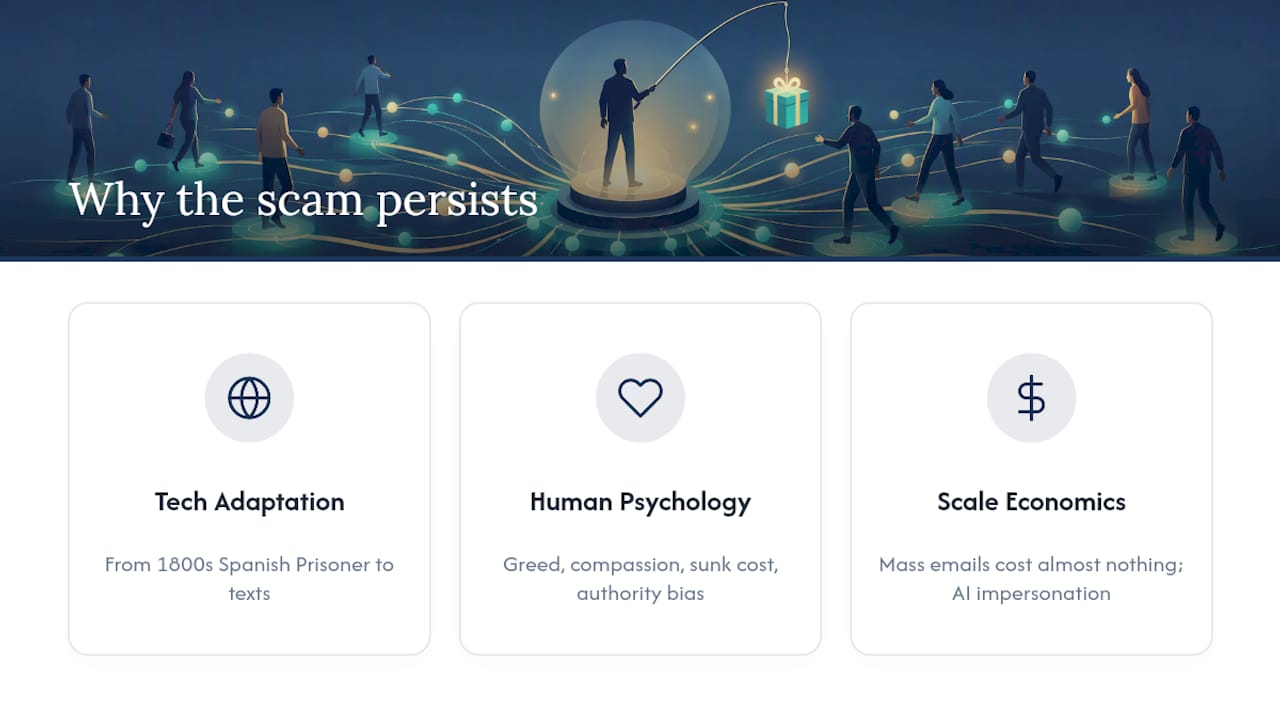
Advance fee fraud didn’t start with email. Its direct ancestor is the Spanish Prisoner con, a scheme dating back to the 1800s, where a con artist claimed to be corresponding on behalf of a wealthy prisoner who needed money smuggled in to secure his release, in exchange for a share of his fortune once he got out. Fax machines carried a version of it in the 1980s and '90s out of Nigeria, where the scam earned the nickname 419 fraud, after the section of Nigeria’s Criminal Code that covers fraud. Email gave it a rocket boost in the '90s and 2000s, and the scam’s structure has kept adapting to whatever communication technology comes next, moving from inboxes to Facebook Messenger, dating apps, LinkedIn, and text messages.
The persistence isn’t a mystery once you look at the psychology. Greed does some of the work: a shot at “free money” short circuits normal skepticism. Compassion does the rest, particularly in romance and charity variants, where the target genuinely believes they’re helping someone in crisis. Once a person has already paid one fee, the sunk cost fallacy kicks in hard: walking away now means admitting the first payment is gone, so many victims keep paying, hoping the next fee is the one that finally unlocks the payout. Authority bias closes the loop. A forged badge, an official looking letterhead, or a scammer posing as a bank compliance officer makes people override their own doubts.
The specific story, a prince, a widow, a lottery board, doesn’t matter. The mechanical structure, money requested up front for a promised payout, is the actual signature of the fraud, and it’s identical whether the message arrives by fax in 1995 or by text in 2026.
Scale economics explain why the scam never dies out. Sending a million emails costs almost nothing, so even a fraction of a percent response rate turns a profit. And the newest wrinkle is AI-driven impersonation, voice cloning and generated video that can now mimic a real relative or executive asking for urgent help, which means visual and audio “proof” is no longer a reliable way to confirm someone’s identity.
What Should You Do the Moment You’re Targeted?
Speed matters here, and so does order. Doing these steps out of sequence wastes time you may not get back.
-
Cut off contact immediately. Don’t respond, don’t negotiate, don’t ask “why” even out of curiosity. Silence protects you.
-
Preserve every piece of evidence. Screenshot the messages, save email headers, keep payment confirmations, and note phone numbers or usernames involved.
-
Call your bank or payment provider right away. If you sent money by wire, ask about a recall request. If it went through a card network, ask about a dispute or chargeback. If it was cash by courier or gift card codes, recovery odds drop sharply, but report it anyway; the sooner your provider knows, the better the odds of any intervention.
-
File a report with IC3 and the FTC. Both agencies use victim reports to build case patterns, even when your individual loss can’t be recovered.
-
Notify your state attorney general’s consumer protection office, especially if the scammer claimed to represent a business or government agency in your state.
-
Lock down your identity if you shared personal details like your Social Security number, ID photos, or bank login information. Set up a fraud alert or credit freeze with the major credit bureaus.
| Who to Contact | What They Do | When to Use It |
|---|---|---|
| Your bank or payment provider | Attempts to trace, hold, or reverse a transfer; flags your account for fraud monitoring | Immediately after any payment, even a small one |
| IC3 | Aggregates internet crime complaints for the FBI; can support broader investigations | Any scam that started or was conducted online |
| Federal Trade Commission | Tracks consumer fraud trends and can pursue civil action against repeat offenders | Any advance fee, lottery, romance, or job scam |
| State attorney general | Handles consumer protection cases and may issue warnings or take local legal action | When a business name, license, or in-state contact was involved |
Don’t skip the report just because you didn’t lose money or you got your funds back. Investigators use the volume and pattern of complaints, not just successful frauds, to identify active scam networks and, in some cases, freeze accounts before more victims get hit.
How Can You Prevent an Advance Fee Scam Before It Starts?
Prevention here isn’t complicated. It’s a short list of habits that, applied consistently, close off almost every version of this scam.
-
Verify independently. If someone claims to represent a bank, government agency, or company, look up the official phone number yourself, don’t use the one in their email or text, and call to confirm.
-
Never pay strangers through irreversible channels. Wire transfers, gift cards, and cryptocurrency should be a hard no for anyone you haven’t met and verified in person or through a trusted, established relationship.
-
Guard your personal information. Don’t share your Social Security number, bank login credentials, or scanned ID documents with anyone who contacted you first.
-
Turn on two-factor authentication for your email and financial accounts, so a stolen password alone can’t get a scammer into your accounts.
-
Check the actual URL before clicking any link in an unexpected email. A domain that’s almost right (like “paypa1.com” instead of “paypal.com”) is a classic sign of a phishing setup layered on top of the advance fee pitch.
-
Slow down attachments. Don’t open unexpected invoices, “official documents,” or shipping forms from someone you don’t know.
-
Pause when pressured. If a message insists you act “today” or “before the deadline,” that urgency is the scam working as designed. A real opportunity survives a 24 hour delay while you check it out.
Pro Tip: When in doubt, don’t decide alone. Forward the message to a family member, a bank fraud line, or a resource like Scruteon’s free advice page, where you can get a second set of eyes before you act.
None of this requires technical skill. It requires slowing down at exactly the moment the scammer is counting on you to speed up.
Where Should You Report an Advance Fee Scam?
Different agencies serve different purposes, and using more than one isn’t overkill, it’s how the system is designed to work.
-
Use IC3 for anything that started or moved online: email, social media, messaging apps, or a fake website.
-
Use the FTC for consumer fraud broadly, including phone based and mail based advance fee schemes.
-
Contact your state attorney general’s consumer protection office when a specific business name, license number, or local contact was part of the pitch.
-
Contact your bank or payment provider first if money has already moved, since time affects whether a trace or hold is even possible.
-
For investment-flavored versions (fake brokers, guaranteed returns, “finder’s fees”), Investor has focused guidance and a way to check whether someone is a registered broker.
Filing a report even when you never sent money still matters. Complaint volume helps investigators spot new scam operations before they hit their next round of targets.
How Scruteon Helps You Stay Ahead of Scams Like This
Scruteon exists to make scam awareness simple, not exhausting. The newsletter sends one or two concise emails a week covering real, current scams, written in plain language for readers who don’t have time to parse legal jargon or technical security terms.
-
Weekly alerts break down active scams (romance, tech support, phishing, and advance fee schemes) in a few minutes of reading.
-
The free advice page lets you submit a suspicious message, email, or offer and get a straight answer on whether it looks like a scam.
-
No submission requires sharing sensitive account numbers or passwords, so you can ask for help safely.
-
Everything is free, aimed at everyday internet users rather than security professionals.
If you’ve ever gotten a message and thought “this feels off, but I’m not sure,” that’s exactly the gap Scruteon’s advice page and newsletter are built to close.
Who Do Advance Fee Scammers Target Most?
There’s no single victim profile, which is part of what makes this fraud so durable. Scammers run wide nets and adjust the pitch to whoever responds.
Older adults show up disproportionately in loss reports, partly because retirement savings make a bigger prize worth chasing, and partly because some seniors are less familiar with newer payment scams involving crypto or gift cards. But that’s far from the whole picture. Job seekers, especially people newly unemployed or looking for remote work, are prime targets for the fake employer variant. Small business owners get hit with “finder’s fee” investment pitches and fake supplier deals. People going through divorce, grief, or financial stress are targeted more often for romance and recovery scams, since emotional vulnerability lowers normal skepticism.
Education level and income don’t offer much protection either. Advance fee fraud has snared doctors, lawyers, and finance professionals, people who arguably should know better, because the con is built around exploiting a moment of hope or urgency, not a gap in general intelligence. Anyone checking email, using a dating app, or job hunting online is a plausible target on any given day.
What Legal Penalties Do Advance Fee Scammers Face?
In the United States, advance fee fraud typically falls under wire fraud and mail fraud statutes, both federal crimes that carry serious weight because they involve using interstate communication systems to defraud people. A conviction can bring years in federal prison plus restitution orders requiring the offender to repay victims, though actual recovery of funds is rare even after conviction.
When scams cross borders, which most do given how many operations run out of West Africa, Eastern Europe, and parts of Asia, prosecution gets far harder. U.S. authorities can charge someone in absentia or coordinate with international law enforcement, but extradition and asset seizure across jurisdictions take years and don’t always succeed. That’s a major reason prevention and early reporting matter more than betting on eventual prosecution.
Additional charges often stack on top of the base fraud count: identity theft if the scammer used a stolen or fake identity, money laundering if funds moved through multiple accounts to obscure their origin, and conspiracy charges when multiple people ran coordinated roles in the scheme.
How Do Investigators Build a Case Against These Networks?
Advance fee fraud cases start with pattern recognition. IC3 and the FTC collect individual complaints, then look for shared phone numbers, email templates, bank account numbers, or wallet addresses that link separate victim reports into a single operation.
From there, investigators can subpoena financial records from banks or payment processors to trace where money moved after it left the victim’s account. Cryptocurrency transactions, despite their reputation for anonymity, leave a public ledger trail that forensic analysts can follow to an exchange, where a subpoena can sometimes unmask the account holder. Wire transfers through services like Western Union leave a pickup record tied to an ID, though scammers often use fake identification or hire local runners to collect the cash.
International cooperation is where most cases stall or succeed. Task forces involving the FBI, Interpol, and local law enforcement in countries with high scam activity have made coordinated arrests, but jurisdictional gaps and corruption in some regions mean plenty of operators never face charges. Victim reports remain the raw material for all of it. Without a critical mass of complaints pointing to the same operation, cases rarely get enough investigative priority to move forward.
What Do Real Advance Fee Scam Cases Actually Look Like?
The classic 419 story, an email promising millions from a deceased foreign official, might feel like ancient internet folklore, but the format never really left, it just moved platforms. Modern versions arrive as LinkedIn messages from “investors,” Facebook posts about unclaimed inheritances, or texts about a package held at customs pending a small fee.
Job scam cases follow a near-identical pattern every time: a remote position appears on a job board with pay that seems slightly too good, the “employer” moves the conversation to a personal messaging app fast, and once you’re hired, they mail you a check to cover home office equipment, ask you to deposit it, then wire back the “difference” to a vendor. The check bounces days later, and the victim is on the hook for the entire wired amount.
Romance scam cases share a slower arc. Weeks or months of daily messages build a real emotional connection before any money enters the conversation, which is exactly why these cases hit victims so hard financially and emotionally. The first ask is usually small and sympathetic, a stuck shipment, a medical bill, then escalates once trust is established.
Recovery scams close the loop cruelly: someone who lost money to an initial scam gets a follow up call from a “fraud recovery specialist” who, for a fee, promises to get it all back. It never does.
What Actually Matters Most Here
The conventional advice on scams tends to focus on spotting bad grammar or dodgy email addresses, and that stuff still helps. But the more useful lesson from advance fee fraud’s history is that the story is disposable. Princes, widows, lottery boards, recovery agents, they’re interchangeable skins on the exact same mechanism: pay first, get paid never.
Most people don’t get caught because they’re gullible. They get caught because the request arrives at a moment of financial stress, loneliness, or genuine hope, and the scammer has built an entire industry around timing that moment well. That’s the part conventional prevention tips skip: this isn’t really a technology problem, it’s a pressure problem. The fix isn’t learning to spot every new scam template; templates change monthly. The fix is building one reflex: any unsolicited request for upfront money, no matter how official it looks, gets verified independently before a single dollar moves. If you build that single habit, you’ve closed off the entire category, not just today’s version of it.
The information in this article is for educational purposes only. Scam tactics change fast, and we cannot guarantee that this information is always complete or up to date.
By reading this article, you agree that Scruteon is not responsible for any financial losses, fraud, or damages that occur if you rely on this content. This is not professional financial or legal advice. If you suspect you are a victim of a scam, please contact your bank or local law enforcement immediately.
Sources
-
Advance fee fraud — Washington State Department of Financial Institutions
-
A brief history of the internet’s favorite scam — The Reader (MIT Press)