
If someone calls claiming to be from the IRS and demands payment or threatens arrest, hang up. That's a scam, full stop. The IRS itself confirms it doesn't initiate contact this way, and the Treasury Inspector General for Tax Administration (TIGTA) exists specifically to chase down these callers. Don't give out your Social Security number, bank details, or a single dollar. Hang up first, ask questions later.
TL;DR:
- Most IRS scam calls are unexpected, threaten immediate action, and request sensitive information or payments via gift cards, wire transfers, or cryptocurrency.
- The real IRS contacts taxpayers only through mailed notices before any phone communication, and never demands immediate payment or asks for personal details upfront.
- Always hang up immediately on suspicious calls, record caller details, and verify any claims with the official IRS website or by calling the IRS directly.
- Reporting scam calls to TIGTA, the IRS, or the FTC helps authorities track and dismantle these operations, especially as scammers now use AI and caller ID spoofing.
- Building a routine with secure contact info, alerts, and pre-emptive education for at-risk relatives significantly reduces the risk of falling victim.
Table of Contents
- What an IRS Scam Call Actually Sounds Like
- How the IRS Actually Contacts You
- What to Do the Moment a Suspicious Call Comes In
- Where to Report an IRS Scam Call
- Why These Calls Are Getting Harder to Spot
- Building a Defense Routine, Especially for Seniors
- Stay Ahead of the Next Scam Call
- Where to Verify or Report an IRS Scam Call
- Sources
- FAQ
What an IRS Scam Call Actually Sounds Like
Scam calls follow a pattern once you know what to listen for. The IRS lists specific tells: the call is unexpected, it rushes you, it threatens you, or it asks for money or personal details on the spot. Real tax problems don't work at that speed.
Here's what should set off alarms the moment you hear it:
- The call comes out of nowhere, with no prior letter from the IRS
- The caller pressures you to act "right now" or "before it's too late"
- Threats of arrest, deportation, or license suspension
- Demands for payment by gift card, wire transfer, cryptocurrency, or prepaid debit card
- Requests for your Social Security number, bank account, or IRS PIN over the phone
- A caller ID that shows "IRS" but the number looks odd, or a callback number that isn't listed anywhere official
- Scripted talk about a "case number," "referral number," or a made-up department name
Statistic to know: the IRS reported more than 600 social media impersonators in fiscal year 2025 alone. Phone calls are often just one piece of a bigger con that starts somewhere else entirely, like a fake profile or a text message.
How the IRS Actually Contacts You
The real IRS is slow, boring, and paper based, which is exactly why the fast talking phone version is fake. The agency mails a written notice before any phone contact happens. No letter, no legitimate call. That's the rule almost every scam breaks.
A few things the actual IRS will never do on a first call:
- Demand immediate payment without giving you the chance to question or appeal what you owe
- Ask for payment by gift card, cryptocurrency, wire transfer, or prepaid card
- Threaten to send police or immigration agents to your door
- Ask for your full Social Security number or bank login over the phone
Private collection agencies do sometimes call on the IRS's behalf, but only after the agency has already mailed you a notice assigning your account to one. If you're unsure whether a prior contact was real, don't call the number the caller gave you. Look up the IRS's official number on IRS.gov and ask them directly whether your account has any activity.
What to Do the Moment a Suspicious Call Comes In
Treat every unexpected IRS call as fake until proven otherwise, because that's usually exactly what it is. Here's the order of operations:
- Hang up immediately. Don't press any keys, don't stay on the line "just to see," and don't argue with the caller.
- Write down the caller ID number and any callback number they gave you, even if it looks like a random cell phone.
- Note the exact time, date, and what they said, including any "case number" or department name they used.
- Screenshot or save the voicemail if they left one. This preserves the exact evidence investigators need.
- Block the number on your phone, then check your bank and card statements for anything unusual.
- Call your bank or card issuer immediately if you gave out any account or payment information, even partial.
- Freeze your credit and notify the credit bureaus if you shared your Social Security number or other identifying details.
Pro Tip: Never call back a number the scammer gave you, even to "confirm" something. Look up the IRS's official contact information yourself at IRS.gov, or check your own IRS online account to see if anything is actually pending.
If you're helping an older relative through this, our guide on reporting elder fraud walks through the same steps with extra detail on preserving evidence.
Where to Report an IRS Scam Call
Reporting does more than protect you. It feeds data to the agencies actively working to shut these operations down. The main channels:
- TIGTA hotline: 800-366-4484, the direct line for reporting IRS impersonation by phone
- phishing@irs.gov, for forwarding scam emails, texts, or details from a phone call
- IRS.gov/SubmitATip, the IRS's own tip submission form
- ReportFraud.ftc.gov, the FTC's general fraud reporting portal
- The FCC consumer complaint center, specifically for caller ID spoofing
When you file a report, include as much as you can: the date and time of the call, the caller ID and any callback number, a rough transcript of what was said, the payment method requested, and any linked email addresses or websites they mentioned. TIGTA has reported that fuller reports with specific numbers and phrasing help investigators connect calls to known scam operations faster than vague tips.
Why These Calls Are Getting Harder to Spot
Scammers are using AI-generated voices to sound like real IRS agents or even law enforcement officers, and the quality has jumped noticeably in the past year. Add spoofed caller ID that displays "Internal Revenue Service" or a Washington, D.C. area code, and the whole setup can pass a quick gut check.
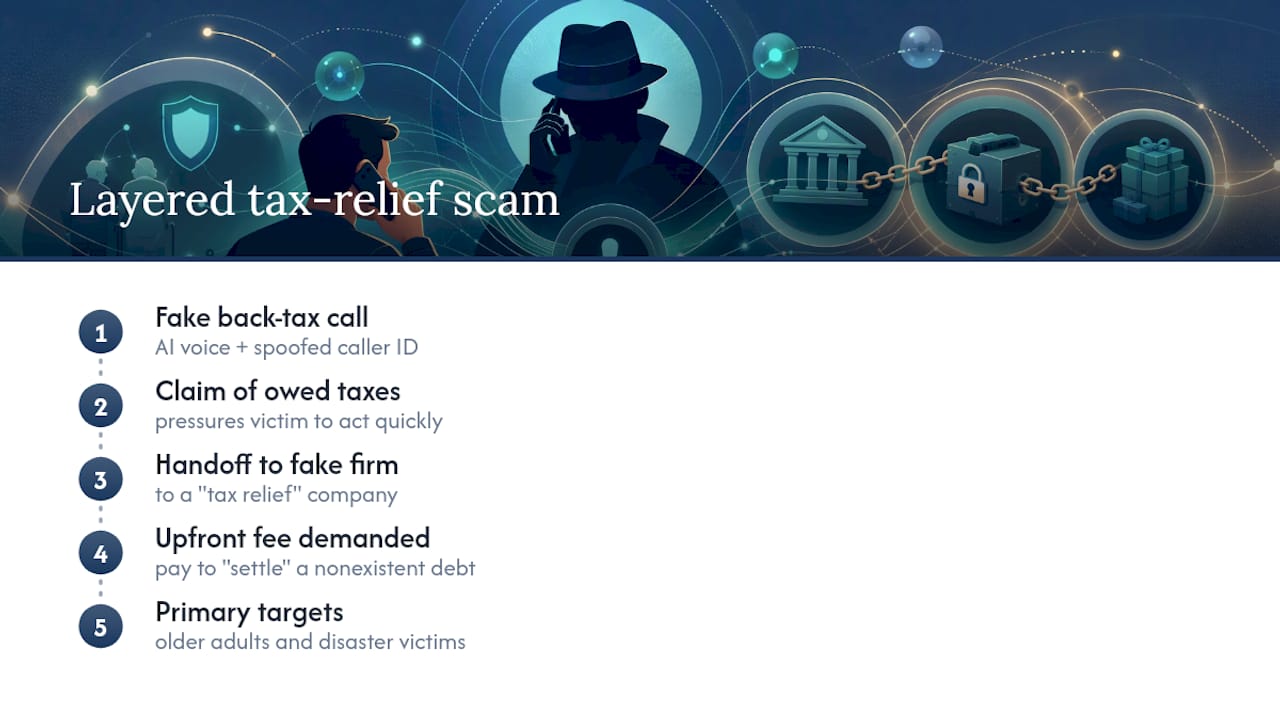
The more dangerous version is layered, a tactic explained well in Passport Expeditor Scams: How to Spot and Report Fraud. A phone call claims you owe back taxes, then hands you off to a fake "tax relief" company that charges an upfront fee to "settle" a debt that never existed in the first place. The FTC has documented this exact pattern repeatedly. Older adults and disaster victims get targeted hardest, often with fake promises of refunds or casualty-loss help, which is exactly why caregivers need a plan before the call ever comes.
Building a Defense Routine, Especially for Seniors
The best protection isn't a single decision made under pressure. It's a routine built in advance, before anyone's on the phone feeling rushed.
- Save the IRS's official number in your phone now, so you're never tempted to call back a number a stranger gave you
- Set up bank and card alerts for any withdrawal or transfer over a small threshold
- Practice the scam script out loud with older relatives so the real thing feels familiar instead of scary
- Agree on a trusted contact, someone to call before sharing anything sensitive, no exceptions
- Turn on carrier spam-blocking and report persistent numbers to your phone's blocklist
Pro Tip: Role-playing a fake IRS call with a parent or grandparent sounds silly until it works. Scammers count on the shock of the moment. Familiarity kills that shock.
Our breakdown of numbers seniors and caregivers should save to block Medicare scam calls uses the same logic and pairs well with this routine. And if a call turns into a demand for an upfront "processing fee," it's worth reading how advance fee scams typically unfold, since the tactics overlap heavily with fake tax relief pitches.
Stay Ahead of the Next Scam Call
Reading one article won't cover the next tactic scammers roll out, and they roll out new ones constantly.
 Scruteon sends a free newsletter that breaks down real scams as they're happening, in plain language, without the jargon. One or two emails a week cover new tactics across romance scams, phishing, tech support fraud, and elder fraud, including the IRS impersonation calls covered here. If you're not sure whether something that happened to you (or a parent, or a neighbor) was a scam, you can also just ask. Scruteon's free advice contact page lets you describe a suspicious call or message and get a straight answer back. Sign up for the newsletter at Scruteon and get the next scam pattern in your inbox before it reaches your phone.
Where to Verify or Report an IRS Scam Call
For quick reference: the IRS's own guide on impersonation scams, the TIGTA reporting hotline and page, the FTC's consumer alert on back-tax call scams, and the FCC's page on tax-season phone scams for spoofing complaints.
This article is general information, not a substitute for advice from a qualified financial advisor. Consult a qualified financial professional about your own circumstances before acting on anything here.
Sources
FAQ
Why am I getting so many fake IRS calls lately?
Scammers are running larger volumes of AI-assisted robocalls with spoofed caller IDs, and the IRS has flagged rising impersonation activity heading into 2026, including calls that reference fake case numbers to sound official.
Will the IRS ever call me by phone?
Rarely, and only after mailing a written notice first; an unexpected call with no prior letter, especially one demanding immediate payment, is not how the IRS initiates contact.
Is there a specific IRS phone scam going around right now?
Yes. A common current version claims you owe back taxes, then transfers you to a fake "tax relief" company that charges illegal upfront fees, a pattern the FTC has warned about directly.
How do I stop getting IRS scam calls?
You can't fully stop robocalls, but blocking numbers after each call, using your carrier's spam filter, and reporting each incident to TIGTA and the FCC helps reduce repeat targeting over time. Checking known red flags with a resource like Scruteon's scam warning sign guide also helps you recognize new variations as they appear.
Recommended
- Stop Robocalls Now: 2-Minute Checklist for U.S. Phones
- 7 Numbers Seniors & Caregivers Must Save to Stop Medicare Scam Calls
- Spot Scam Warning Signs in 5 Minutes, Verify and Report (U.S.)
- The One Ring Scam: Why You Should Never Call Back
The information in this AI-assisted-generated article is for educational purposes. Scam tactics change fast, and we cannot guarantee that this information is always complete or up to date.
By reading this article, you agree that Scruteon is not responsible for any financial losses, fraud, or damages that occur if you rely on this content. This is not professional financial or legal advice. If you suspect you are a victim of a scam, please contact your bank or local law enforcement immediately.