
If you suspect elder fraud, call the National Elder Fraud Hotline at 833‑FRAUD‑11 (833‑372‑8311) right now for a case manager who can walk you through next steps. File a complaint with the FBI's Internet Crime Complaint Center if the scam happened online, and report it separately at Reportfraud. If the older adult is in immediate danger or a caregiver is actively taking money right now, call 911 or your local Adult Protective Services office first.
TL;DR:
- The National Elder Fraud Hotline can help sort cases, but it does not investigate and advises quick reporting of large losses within two to three days.
- Filing reports with IC3, FTC, and APS should be organized with evidence like transaction details and screenshots, and partial reports are still valuable for pattern detection.
- Most scams follow familiar scripts such as grandchild impersonations, fake tech support, or romance schemes, with warning signs including sudden secrecy or unexplained withdrawals.
- Victims should verify suspicious contacts by checking domain URLs and calling back only numbers from official sources, avoiding paying for recovery services or sharing personal info.
- Speedy reporting increases chances of freezing funds or recovering money, but scammers are known to impersonate the hotline itself, making verification crucial.
Table of Contents
- Where to Report Elder Fraud: Matching the Problem to the Right Agency
- Building a Report Packet and Filing Your Reports
- What Happens After You File a Report
- Recognizing Elder Fraud Before It Gets Worse
- Verifying Real Help and Avoiding Impersonation Scams
- Where to Report and Learn More
- Sources
- FAQ
Where to Report Elder Fraud: Matching the Problem to the Right Agency
Different agencies handle different pieces of the elder fraud puzzle, and knowing which one to call first saves hours of frustration. Here's how the main channels break down.
- National Elder Fraud Hotline (833‑FRAUD‑11 / 833‑372‑8311): Run by the Department of Justice's Office for Victims of Crime, this hotline connects callers age 60 and older, or someone reporting on their behalf, with a case manager who explains options and can help file reports with other agencies. It operates Monday through Friday, 10 a.m. to 6 p.m. ET, and does not investigate cases itself.
- FBI Internet Crime Complaint Center (IC3): File here when the fraud involved email, a fake website, a romance scam that started online, or any tech support scheme. IC3 is the FBI's central intake point and routes complaints to law enforcement partners who may pursue an investigation.
- Federal Trade Commission (ReportFraud.ftc.gov): Use this for telemarketing scams, fake prize notifications, or general consumer fraud. The FTC folds every report into its Consumer Sentinel database to spot patterns across the country, though it rarely resolves individual cases directly.
- Adult Protective Services (APS) and local police: Call your state's APS office when a caregiver, relative, or trusted person is exploiting the older adult financially or physically. Call 911 or local police when someone is in danger right now.
- U.S. Postal Inspection Service: If a scam arrived by mail, a fake sweepstakes letter or a check fraud scheme, report it to USPIS online or at 877-876-2455.
Building a Report Packet and Filing Your Reports
A little organization before you pick up the phone makes every report faster and more useful to investigators. Here's the order that works best.
- Gather the paper trail first. Write down exact dates and times of contact, phone numbers or email addresses used, names given (even fake ones), and every transaction detail: amounts, account numbers, wire routing information, and gift card codes if any were used.
- Save the evidence itself. Screenshot text messages, emails, and social media conversations before the scammer can delete their profile or block you. Note any witnesses, including bank tellers or family members who were present.
- Call the hotline first if you're unsure where to start. A case manager at 833‑FRAUD‑11 can help sort out whether this belongs with IC3, the FTC, APS, or all three, and can submit certain reports on your behalf.
- File the online forms. IC3.gov and ReportFraud.ftc.gov both ask for contact details, a description of what happened, and transaction specifics; both let you attach screenshots or documents. The CFPB recommends including any concerns about memory loss or diminished capacity, since that context matters to investigators.
- Contact APS or local police separately if a caregiver, family member, or in-home aide is involved. These agencies handle exploitation cases that IC3 and the FTC aren't built to address.
Pro Tip: File even if your information feels incomplete. The CFPB and hotline staff both stress that a partial report today beats a perfect report next week, since agencies use incomplete tips to build patterns and can follow up for details later.
When cognitive impairment is a factor, involve APS early. Case workers there are trained to assess capacity and can coordinate with a physician or legal guardian if the situation calls for it. When the suspected perpetrator is a family caregiver, expect the process to move slower and involve more sensitivity, but don't let that delay your report.
What Happens After You File a Report
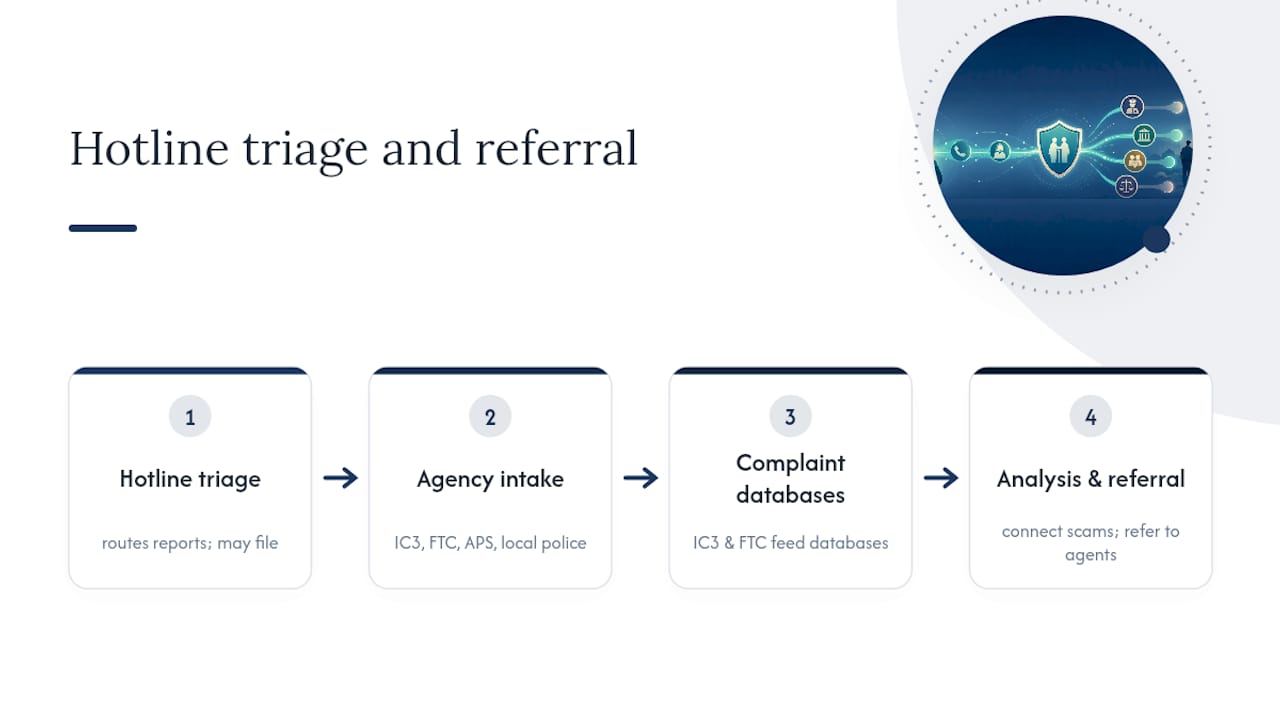
The hotline's case managers don't investigate. Their job is triage: pointing you toward IC3, the FTC, APS, or local police, and sometimes filing those reports for you so you don't have to repeat your story three times. IC3 and the FTC both work behind the scenes, feeding complaints into databases that analysts use to connect similar scams, identify repeat offenders, and refer strong cases to field agents.
Speed matters more than most people realize. Reporting large financial losses within two to three days of discovery meaningfully improves the odds that a bank can freeze a wire transfer or that investigators can trace where the money went. For high-dollar cases, the FTC has referred victims to the FBI's IC3 Recovery Asset Team, which has helped freeze and recover funds in some situations, though recovery is never guaranteed once money has left the country or moved through cryptocurrency.
Keep every reference number you receive. Your hotline case manager will give you a name and callback number, IC3 issues a complaint ID, and the FTC generates a report number. Save all three; you'll need them if a bank, detective, or the hotline itself calls back for follow-up.
Recognizing Elder Fraud Before It Gets Worse
Scams targeting older adults tend to follow familiar scripts: a "grandchild" in jail needing bail money, a fake tech support pop-up demanding remote access, a romance interest who never quite manages to visit, or a new "friend" who suddenly wants power of attorney. Financial exploitation by a trusted caregiver often looks less dramatic. Missing checks, unexplained ATM withdrawals, or a sudden new "joint" bank account are common warning signs.
Watch for behavior changes too: secrecy about finances, sudden anxiety around a particular caller, or unpaid bills despite adequate income.
If you catch it early, act immediately:
- Call the bank or credit card company to freeze the account or reverse a pending transaction.
- Change passwords on any account the scammer may have accessed.
- Pull credit reports and consider a credit freeze if personal information was exposed.
- Call 911 if the older adult is in physical danger or being coerced.
- Screenshot everything before accounts get deleted or numbers get blocked.
Verifying Real Help and Avoiding Impersonation Scams
Here's an ugly twist: scammers now impersonate the National Elder Fraud Hotline itself, calling victims back and pretending to "help" them recover money while actually stealing more. The hotline itself warns that if you get a suspicious follow-up call claiming to be from OVC or law enforcement, don't give out personal information or send money. Report the impersonation to the FTC, then call the real hotline number to let staff know it happened so they can track the pattern.
A few habits keep you safe:
- Only trust phone numbers and links found on a
.govdomain, not ones a caller reads to you. - Never provide a Social Security number, bank login, or payment to anyone who contacted you first.
- Hang up and call the hotline back directly at 833‑FRAUD‑11 to confirm any claim.
| Verification step | Why it matters |
|---|---|
| Check the domain ends in .gov | Scammers often mimic official sites with lookalike URLs |
| Call back using a number you found yourself | Confirms you're not talking to the original scammer |
| Never send money to "recover" stolen funds | Recovery scams target people who already lost money once |
Scruteon covers scam patterns like this in its newsletter, and readers who spot a message they're not sure about can submit it through Is This a Scam? Ask for Free Advice for a quick human read before responding to anyone.
If you're supporting a relative who receives care at home, the caregiving resources at From Love With Care offer practical guidance on staying alert to financial exploitation during day-to-day caregiving.
Where to Report and Learn More
- National Elder Fraud Hotline: 833‑FRAUD‑11, case manager support
- IC3: internet-based scams
- Reportfraud: general fraud reports
- CFPB reporting guide: what to include
For ongoing scam alerts and free guidance on suspicious messages, Scruteon's newsletter breaks down new fraud tactics in plain language twice a week.
This article is general information, not a substitute for advice from a qualified financial advisor. Consult a qualified financial professional about your own circumstances before acting on anything here.
Sources
- Providing help, restoring hope | National Elder Fraud Hotline
- Internet Crime Complaint Center (IC3)
- Report fraud | Federal Trade Commission
- Reporting elder financial abuse | Consumer Financial Protection Bureau
FAQ
What Counts as Elder Fraud?
Elder fraud covers financial exploitation, scams, and abuse targeting people typically age 60 and older, including romance scams, tech support fraud, telemarketing schemes, and theft by a caregiver or family member.
How Do I Report Someone Scamming an Older Adult?
Call the National Elder Fraud Hotline at 833‑FRAUD‑11 for guidance, then file a complaint with IC3 if it happened online or with the FTC for general scams, and contact APS or police if a caregiver is exploiting them.
What Evidence Do I Need to Report Fraud?
Gather exact dates and times, names or phone numbers used, transaction and account details, and screenshots of any messages, since the CFPB notes that even partial information is worth submitting.
What Evidence Proves Elder Financial Abuse?
Bank records showing unusual withdrawals, changed account access, missing checks, or a sudden new authorized user, combined with dates and witness observations, give investigators the clearest starting point for a financial abuse case.
Recommended
- Prevent Identity Theft: 3 Actions That Block Most Takeovers
- Advance Fee Scam: How to Spot It and Stop It Cold
- Catfishing Scams: How to Spot Them and Respond Fast
- The One Ring Scam: Why You Should Never Call Back
The information in this AI-assisted-generated article is for educational purposes. Scam tactics change fast, and we cannot guarantee that this information is always complete or up to date.
By reading this article, you agree that Scruteon is not responsible for any financial losses, fraud, or damages that occur if you rely on this content. This is not professional financial or legal advice. If you suspect you are a victim of a scam, please contact your bank or local law enforcement immediately.