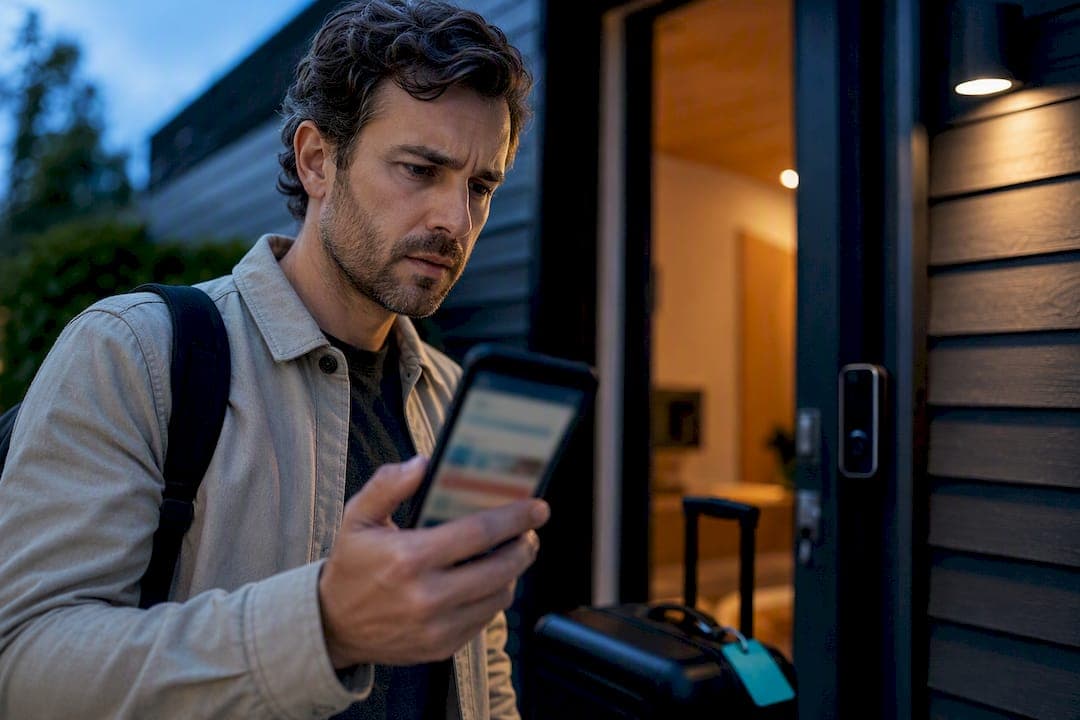
The single best way to avoid a vacation rental scam is to keep every message and every payment inside the official booking platform, and pay with a credit card. If a host pushes you to Zelle, wire transfer, or a personal email, stop, screenshot everything, and contact your card issuer and the platform immediately. When in doubt, run the listing by Scruteon's free advice service before you send a dime.
TL;DR:
- Always keep messages and payments within the official booking platform to preserve protections and avoid falling for fake contact requests.
- Verify listings through reverse-image searches, address confirmation, and activity history before committing, especially if prices are significantly below market rates.
- Pay only via the platform’s checkout with a credit card to enable chargebacks, while avoiding outside transfers like Zelle, Venmo, or gift cards, which are common scam vectors.
- Report any suspicious activity promptly to the platform, FTC, or IC3 within 24 to 48 hours to maximize chances of recovery.
- Be cautious of emotional triggers such as urgent payments, fake emergencies, or manufactured scarcity that scammers use to rush your decision-making.
Table of Contents
- Common Vacation Rental Scam Types You'll Run Into
- Red Flags and a Quick Verification Checklist
- Payment and Messaging: What Keeps You Protected
- What to Do If You've Already Been Scammed
- Scruteon Can Help You Check a Listing Before You Book
- If Something Feels Off Mid-Conversation, Slow Down
- The Emotional Tricks Scammers Rely On
- Staying Ahead of New Scam Patterns
- Official Reporting Channels Worth Bookmarking
- Sources
- FAQ
Common Vacation Rental Scam Types You'll Run Into
Most vacation rental scams fall into a handful of recognizable patterns. Once you've seen them named, they're much harder to fall for twice.
Fake and duplicated listings. Scammers lift real photos and descriptions from legitimate properties, sometimes even the actual address, and post a near-identical version on a lookalike site or a lightly moderated platform. The FTC warns that scammers either invent a property outright or copy a real one, then vanish after collecting payment by wire transfer, gift card, or cryptocurrency.
Hijacked listings. A criminal breaks into a real host's account, or copies their live listing word for word, and starts renting out a property that either isn't theirs or isn't available. These can stay active for weeks because platforms don't always catch the duplication fast, which is part of why victims sometimes find refunds delayed or denied entirely.
Bait and switch. You book one unit, then get a message days before check-in saying it's "unavailable" and you're being moved to a different, usually worse, property, or asked to pay an extra fee to keep your reservation.
Phishing, smishing, and vishing. Fake texts, emails, or even phone calls pretend to be Airbnb or Vrbo support, asking you to "verify" your account or payment method through a link that steals your login credentials. Vrbo's own help center advises opening the app directly rather than clicking any link in an unsolicited message.
- Fake listing: property doesn't exist or was copied from elsewhere
- Hijacked listing: real property, but the account or listing has been taken over
- Bait and switch: last-minute substitution or surprise fee
- Phishing/smishing/vishing: fake support contact designed to steal credentials
Owners get targeted too, usually through overpayment scams involving fake cashier's checks, so the fraud runs in both directions on these platforms.
Red Flags and a Quick Verification Checklist
The biggest warning sign, by far, is any request to pay or talk outside the platform. Once you leave the app or site, you lose the protections that come with it, and you lose most of your ability to dispute the charge later.
Other flags worth watching for: a price noticeably below comparable listings in the same area, a host who won't answer specific questions about the property, reviews that all sound the same or were posted in a tight cluster, and a listing description that doesn't quite match the photos. Analysis from the Federal Reserve's Fed360 points to urgency and underpriced listings as two of the most reliable tells.
Run through this before you book anything that feels even slightly off:
- Reverse-image search the main photos using Google Images or TinEye. If the same picture shows up under a different address, city, or rental site, that's your answer.
- Search the property address on a mapping tool and a county property records site to confirm ownership roughly matches the host's name or a rental management company.
- Search the listing title and address in quotes to see if it appears twice on different platforms at different prices.
- Check how long the host has been active and how many reviews they have. A brand-new account with five-star reviews posted the same week is worth a second look.
- Test the urgency. A real host doesn't disappear or threaten to cancel your discount if you take an hour to think it over.
Pro Tip: Copy a sentence or two of the listing description into a search engine in quotation marks. If it turns up on three other sites with three different addresses, you've found a copy job, not a rental.
Payment and Messaging: What Keeps You Protected
Card payments give you leverage a wire transfer never will. If a booking goes bad, a credit card lets you file a chargeback with your bank, and the BBB notes that this dispute path is far stronger than what you get with wire transfers, gift cards, or peer-to-peer apps like Zelle, Venmo, or Cash App, which are built to be fast and largely irreversible.
- Pay only through the platform's checkout, never through an outside invoice or payment link
- Treat any request for Zelle, Venmo, Cash App, wire transfer, or gift cards as an automatic red flag
- Keep every conversation inside the platform's messaging system, not personal email or text
- Log into the app directly to verify any "support" message instead of clicking a link inside it
- Never send a copy of your driver's license or passport unless you've independently confirmed the request is real and required
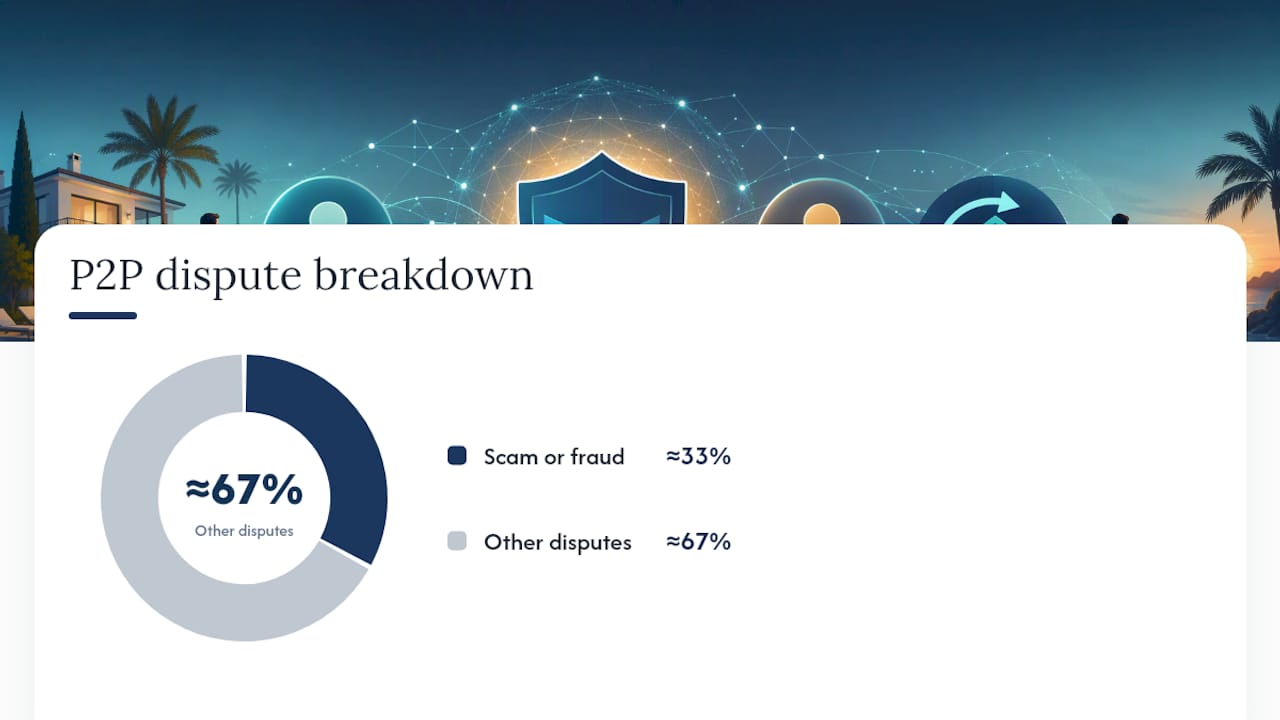
Roughly a third of P2P payment disputes involve some kind of scam or fraud claim, according to Scruteon's breakdown of Venmo scam patterns, and recovery windows on those apps are narrow and inconsistent.
If a host pushes back, a simple, firm line works: "I only book and pay through the platform. If that's not possible, I'll need to cancel." A legitimate host has no reason to argue with that.
What to Do If You've Already Been Scammed
Move fast. The first 24 to 48 hours matter more than any step that comes after.
- Take screenshots of the full listing, every message, and your payment confirmation before anything gets deleted or the account disappears.
- Call your card issuer or bank immediately to dispute the charge or request a hold. This is your strongest recovery path if you paid by credit card.
- Report the listing to the platform through its official fraud or trust and safety channel, and save the confirmation number or ticket ID.
- File a report with the FTC at reportfraud.ftc.gov, and file with the Internet Crime Complaint Center (IC3) if the amount is significant or the scam crossed state lines.
- File a police report if you shared financial or identity information, and consider a fraud alert or credit freeze if you sent copies of ID documents.
Travel and vacation fraud shows up consistently among the more commonly reported categories in IC3's 2024 Annual Report, which is exactly why filing your report matters even if you don't expect the money back. It builds the case history that eventually gets platforms and prosecutors to act.
Scruteon Can Help You Check a Listing Before You Book
Scruteon's free scam prevention guide breaks down real scam patterns, including rental fraud, in plain language twice a week. If a listing feels off but you can't put your finger on why, ask for free advice and get a second opinion before you pay anything.
Sign up before you book your next trip, especially during peak travel weeks when fake listings surge.
If Something Feels Off Mid-Conversation, Slow Down
The moment a conversation with a host starts feeling wrong, whether it's a strange request, a sudden change in tone, or pressure to move fast, stop responding and give yourself room to think.
Don't send anything else until you've checked the account independently. Log into the platform through your browser or app, not through any link the host sent you, and look at their profile, review history, and response rate. If the account was created recently or has no verified reviews, that's information worth having before you type another word.
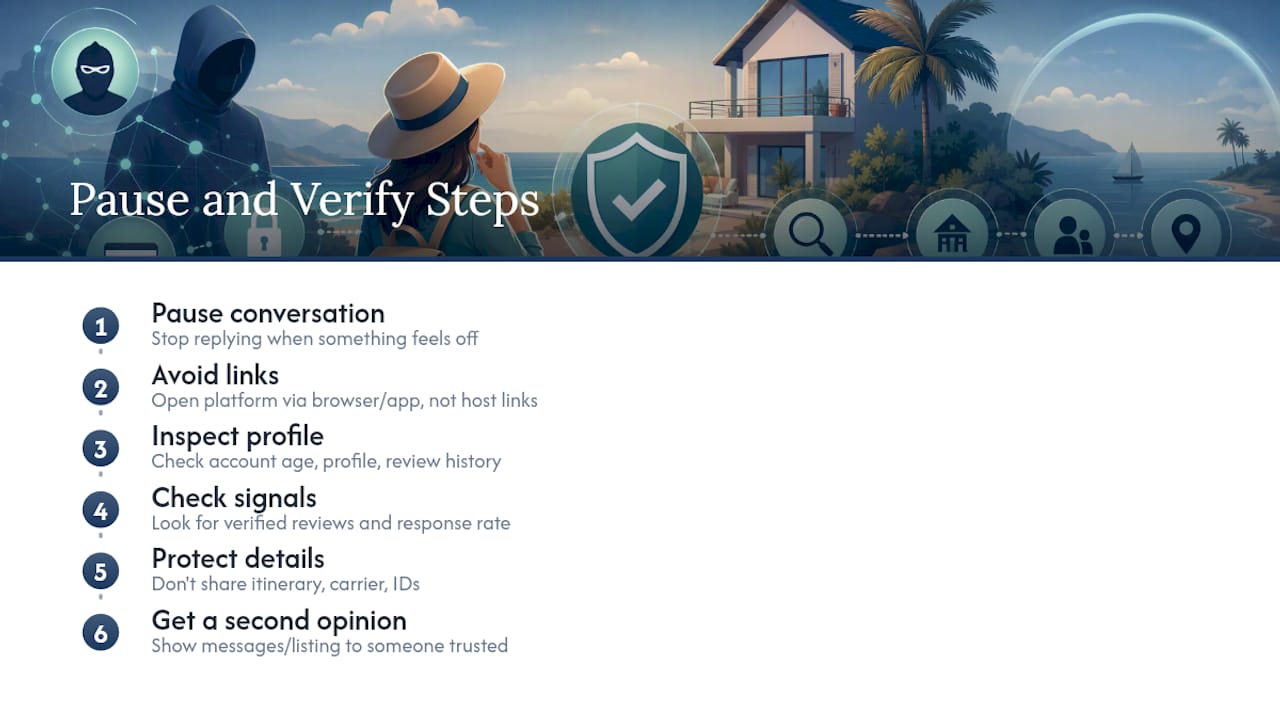
Avoid handing over personal details during this pause. You don't need to share your full travel itinerary, your phone carrier, or identity documents just to confirm availability. A real host only needs enough information to complete the booking through the platform itself.
This is also the moment to get an outside opinion. Send the listing link and the suspicious messages to someone you trust, or run it past Scruteon's advice service, which exists specifically for this kind of "is this real or not" moment. A five-minute pause has saved plenty of travelers from a payment they'd never get back. There's no booking discount worth skipping that step.
The Emotional Tricks Scammers Rely On
Scammers targeting travelers rarely lead with numbers. They lead with feelings, because urgency and sympathy shut down the skepticism a good deal should trigger.
One common tactic is the fake emergency: the host suddenly needs payment today because of a "family situation" or a "system error" that only a wire transfer can fix. Another is overpromising. The listing photos show a pool, a private hot tub, and ocean views, all for a price well under everything else in the area, because the goal is to get you emotionally attached to the property before your guard is up.
Some hosts lean on flattery or fake rapport, chatting casually before ever mentioning money, building a sense of trust that makes the eventual off-platform payment request feel like a favor between friends rather than a red flag. Others use manufactured scarcity: "three other people are looking at this right now" is a pressure tactic as old as timeshare sales, just repackaged for a rental listing.
The through line in all of these is the same: they want you to act before you verify. Genuine hosts with a real property and a real track record don't need you to skip your own due diligence, and a discount that requires urgency is rarely a discount at all.
Staying Ahead of New Scam Patterns
Scam tactics shift constantly, so a one-time check isn't enough protection for future bookings. Platform-specific help centers, like Vrbo's guidance on smishing and vishing, update regularly as new impersonation tactics show up, and it's worth a quick read before any big trip.
Traveler forums, particularly community threads on major review sites, often surface active scam patterns faster than official channels because travelers post about bad experiences in real time. Consumer watchdog reporting, like Consumers' Checkbook's investigation into hijacked listings, is another good source, since it digs into patterns platforms don't always publicize.
For ongoing awareness without having to hunt for updates yourself, a short recurring newsletter does the job better than checking a dozen sites. Scruteon's free guide sends one or two concise emails a week covering active scams, including seasonal rental fraud spikes around holidays and summer travel windows. That kind of steady, low-effort awareness is often what catches a scam pattern before it catches you.
Official Reporting Channels Worth Bookmarking
- Report fraud directly to the FTC
- File a complaint with IC3
- BBB's rental scam alert and reporting guidance
- Texas Attorney General's vacation rental scam guidance
Sources
- Rental listing scams - FTC
- BBB Scam Alert: How to spot this newly common vacation rental scam
- IC3 2024 Annual Report
- Protect your customers from property rental scams this summer - Fed360
FAQ
Is Vacation Rental a Legit Site?
Major platforms like Airbnb and Vrbo are legitimate businesses, but both have been used as venues for fake or hijacked listings, so legitimacy depends on the specific listing and host, not just the platform's name.
What's the Most Common Rental Scam?
The most common pattern is a host convincing a traveler to move payment or communication off the official platform, then collecting money through a wire transfer, gift card, or P2P app that can't be reversed, as the BBB has documented.
How Do You Know if a Vacation Rental Is Legit?
Reverse-image search the photos, confirm the address and ownership independently, check how long the host account has been active, and treat any request to pay outside the platform as a dealbreaker.
Is There an Airbnb Scam Going Around?
Yes. Fake and hijacked Airbnb listings continue to surface, often paired with off-platform payment requests; Airbnb's AirCover can help when you report issues while staying on-platform, but protection weakens significantly once money moves outside the app, according to Norton's rundown of common Airbnb scams.
Recommended
- Spot Scam Warning Signs in 5 Minutes, Verify and Report (U.S.)
- Advance Fee Scam: How to Spot It and Stop It Cold
- Prevent Identity Theft: 3 Actions That Block Most Takeovers
The information in this AI-assisted-generated article is for educational purposes. Scam tactics change fast, and we cannot guarantee that this information is always complete or up to date.
By reading this article, you agree that Scruteon is not responsible for any financial losses, fraud, or damages that occur if you rely on this content. This is not professional financial or legal advice. If you suspect you are a victim of a scam, please contact your bank or local law enforcement immediately.