
A Medicare scam is any attempt to steal your Medicare number, Social Security number, or money through impersonation, fake offers, or threats to cut off your benefits. If someone calls, texts, or emails you about Medicare, don't share any information. Hang up and call 1-800-MEDICARE (1-800-633-4227) yourself to check. Real Medicare representatives never cold-call you demanding payment or personal details.
TL;DR:
- Scammers often use urgent language and fake authority to pressure beneficiaries into revealing their Medicare number or personal details.
- The most common scam tactics include spoofed caller IDs, fake offers for medical equipment or tests, and threats to cancel benefits if no immediate information is provided.
- Never give your Medicare number or bank details to unsolicited callers, and always verify calls by contacting 1-800-MEDICARE directly using official numbers.
- Regularly review your Medicare Summary Notices and online account to identify fraudulent or unauthorized claims promptly.
- Reporting suspected scams to the proper authorities quickly can help prevent further harm and aid investigations into organized fraud rings.
Table of Contents
- How Medicare Scams Work and Why Medical Identity Theft Matters
- Common Medicare Scam Examples and Warning Signs
- Protect Your Medicare Number and Card: Dos and Don'ts
- How to Check Your Medicare Records and Spot Unauthorized Claims
- How to Report a Medicare Scam (Numbers and What to Bring)
- If You Already Shared Information: What to Do Now
- Where to Get Ongoing Scam Alerts and Support
- The Role of the Senior Medicare Patrol in Preventing Scams
- How Medicare Fraud Impacts Beneficiaries and the Healthcare System
- Legal Consequences and Penalties for Medicare Scammers
- Tips for Educating Friends and Family About Medicare Scams
- Sources
- FAQ
How Medicare Scams Work and Why Medical Identity Theft Matters
Scammers don't want your Medicare card as a souvenir. They want the number printed on it, because that number unlocks your entire medical history and your government insurance benefits. Once a criminal has it, they can bill Medicare for equipment you never received, services you never got, or genetic tests you never asked for. This is called medical identity theft, and HHS-OIG identifies it as one of the primary goals behind Medicare scams.
The typical scam flow is simple. A scammer makes contact by phone, text, mail, or in person, often posing as a Medicare representative, a health plan agent, or even a lab technician. They collect your Medicare number, sometimes alongside your Social Security number or bank details. Then they either submit fraudulent claims directly or use your identity to order durable medical equipment (braces, wheelchairs, testing kits) that gets billed to your account and shipped somewhere you'll never see.
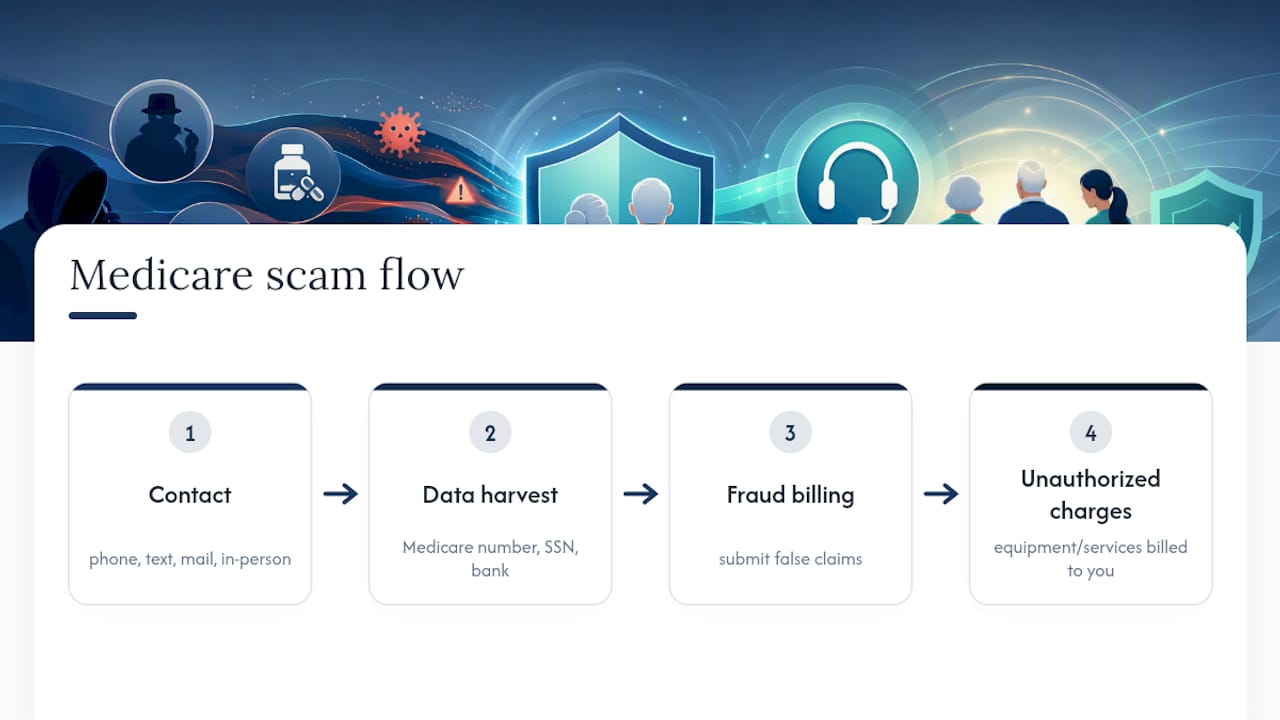
The fallout is not abstract. Fraudulent claims can corrupt your medical records with procedures you never underwent, which creates confusion the next time a real doctor treats you. It can also eat into your benefits, trigger confusing bills, and take months of paperwork to untangle. For caregivers managing a parent's or spouse's care, this kind of mess can delay legitimate treatment while everyone sorts out what's real and what's fraud.
Common Medicare Scam Examples and Warning Signs
Medicare scams show up in a handful of predictable disguises, and once you've seen the pattern, they get much easier to spot. Scammers use high pressure tactics, including fake urgency, fake authority, and fake generosity, all designed to get you talking before you start thinking.
Watch for these tactics:
- Phone imposters with spoofed caller ID that shows "Medicare" or a government-looking number, even though the FCC confirms Medicare never cold-calls beneficiaries for personal information.
- Free offers for genetic testing kits, back braces, or knee sleeves that "just need your Medicare number to process."
- Refund or rebate scams claiming you're owed money but need to verify your Medicare number first.
- Card upgrade or activation calls claiming your card needs reactivating or replacing for a fee.
- Threats to cancel your benefits unless you confirm information immediately.
- Fake websites and phishing emails mimicking Medicare.gov, plus door-to-door visitors claiming to represent Medicare or your plan.
The common thread across all of them is urgency paired with a request for your number. That combination should be your cue to hang up.
Protect Your Medicare Number and Card: Dos and Don'ts
Your Medicare number deserves the same protection as your Social Security number, because in the wrong hands, it functions almost the same way. A few consistent habits close off most of the ways scammers try to get at it.
- Never give your Medicare number, Social Security number, or bank details to anyone who calls, texts, or emails you first.
- Remember that Medicare cards are mailed free of charge. CMS has confirmed there is never a fee to receive or replace one, so any call asking for payment to "activate" or "upgrade" your card is fraudulent.
- If someone claims to be from Medicare, hang up and call 1-800-MEDICARE yourself using the number on your card, not the number they gave you.
- Avoid clicking links in unsolicited texts or emails. Check where a link actually leads before you tap it.
- Shred old or expired Medicare paperwork instead of tossing it in the trash.
- Turn on call-blocking features on your phone, since spoofed caller ID makes many scam calls look legitimate at a glance.
- Set up and monitor a secure account at Medicare.gov so you can check your claims without waiting for paper mail.
Pro Tip: Keep a single index card taped inside a kitchen cabinet with 1-800-MEDICARE, your plan's member services number, and the name and phone number of the family member or caregiver who handles your account. When a scam call catches you off guard, you won't have to think, you'll just grab the card.
How to Check Your Medicare Records and Spot Unauthorized Claims
Your Medicare Summary Notice, or MSN, is a mailed or online statement listing every claim submitted under your Medicare number over the past three months. Reading it carefully is the single best habit for catching fraud early, because it's often the first place a fake claim shows up.
Look for services billed on days you weren't at a doctor's office, equipment you never ordered, or the same service billed twice. Medicare's own guidance recommends comparing dates and services against your personal calendar to catch these mismatches quickly.
Check your online Medicare account monthly if you've had recent appointments, tests, or equipment deliveries, and at least quarterly otherwise. If something looks off, call your health plan or the provider listed on the claim first. Sometimes it's a billing error rather than fraud, but you won't know until you ask.
How to Report a Medicare Scam (Numbers and What to Bring)
Reporting quickly matters, both for stopping further damage to your account and for helping investigators build cases against repeat offenders. Multiple official channels exist depending on what kind of scam you're dealing with.
- 1-800-MEDICARE (1-800-633-4227) for issues with Original Medicare, suspicious calls, or general fraud reports.
- I-MEDIC at 1-877-7SAFERX (1-877-772-3379) for scams involving Medicare drug plans or prescription benefits.
- HHS-OIG for formal fraud complaints, especially involving providers or billing schemes.
- The FTC for identity theft and broader consumer fraud reporting.
- The FBI if the scam involves large-scale fraud, threats, or organized criminal activity.
- Senior Medicare Patrol (SMP) for hands-on help documenting and filing your report.
Before you call, gather your Medicare Summary Notices, the date and time of the suspicious contact, the caller's phone number if you have it, and copies of any suspicious mail, text, or email. Medicare's reporting page walks through the exact process for filing online as well. If the scam involved a threat, in-person contact, or a financial loss, also contact your state consumer protection office or local police.
If You Already Shared Information: What to Do Now
Acting fast limits the damage. Start by checking your Medicare Summary Notices for anything unfamiliar, then call your health plan and any providers listed on questionable claims. AARP recommends contacting Senior Medicare Patrol right away for help documenting exactly what happened and filing the report correctly the first time.
If you gave up your Social Security number, place a fraud alert or credit freeze with the credit bureaus and start the recovery steps at IdentityTheft.gov. Our guide on blocking identity theft takeovers covers the same fundamentals that apply here.
Keep dated notes of every call and report you make, and follow up until any fraudulent claims are actually removed from your record.
Where to Get Ongoing Scam Alerts and Support
Scruteon exists because scam tactics change faster than most people can keep up with, and Medicare scams constantly evolve as scammers adopt new technology to sound convincing. Winston, author at Scruteon, Winston, author at Scruteon, has spent time studying how these schemes evolve and how to explain them in plain language..
Scruteon's free Scam Prevention Guide breaks down real scams as they appear, in one or two short emails a week that take under three minutes to read. There's no jargon and no fear tactics, just the warning signs you actually need. If you or a family member ever gets a call or email that feels off, Scruteon's free advice channel lets you ask a real person before you act on it.
The Role of the Senior Medicare Patrol in Preventing Scams
The Senior Medicare Patrol is a federally funded program that exists specifically to help Medicare beneficiaries recognize, report, and recover from fraud. Unlike a hotline you call once and forget, SMP volunteers and staff work directly with beneficiaries to walk through suspicious paperwork, help distinguish billing errors from genuine fraud, and prepare complete, well documented reports for investigators.
That documentation work matters more than most people realize. SMP helps beneficiaries assemble the specific claim details, dates, and paperwork investigators need, which speeds up how quickly a fraudulent charge gets reversed and removed from a beneficiary's record. Without that structure, a senior trying to fight a fraudulent claim alone often gives up out of sheer frustration with the paperwork.
SMP also runs community education efforts, teaching seniors and caregivers what a scam call sounds like before they ever get one. Every state has an SMP program, usually staffed by trained volunteers, many of them retirees themselves, who understand exactly how confusing Medicare paperwork can be even without fraud involved. If you're a caregiver managing Medicare for a parent, reaching out to your state's SMP office before there's a problem is one of the more overlooked ways to get ahead of it.
How Medicare Fraud Impacts Beneficiaries and the Healthcare System
Medicare fraud doesn't just cost the government money, though the losses at that level run into the billions annually across the program. It costs individual beneficiaries in ways that are harder to measure but just as real.
A corrupted medical record is the most direct harm. When a fraudulent claim adds a procedure, diagnosis, or piece of equipment to your file that never happened, that false information can follow you into future medical decisions. A doctor treating you years later might see a phantom diagnosis and factor it into treatment choices without realizing it's fraud, not fact.
There's also a benefits impact. Some Medicare coverage, particularly for certain equipment or services, has limits. If a scammer uses your number to max out a benefit category with a fraudulent claim, you may find your legitimate need for that same service denied or delayed.
At the system level, fraud drives up costs across the board. Every dollar Medicare pays out on a fake claim is a dollar that isn't available for legitimate care, and widespread fraud contributes to the pressure on premiums and program funding that every beneficiary eventually feels. Reporting scams isn't just self-protection. It's one of the few ways an individual beneficiary can push back against a problem that affects the whole system.
Legal Consequences and Penalties for Medicare Scammers
Medicare fraud is a federal crime, and the penalties reflect how seriously the government treats it. Charges typically fall under healthcare fraud statutes, identity theft laws, and wire fraud statutes when the scam involves phone or electronic communication, which most modern Medicare scams do.
Convictions can carry significant prison time, often measured in years rather than months, along with steep fines and mandatory restitution to Medicare for fraudulently billed amounts. Healthcare providers convicted of fraud can also lose their ability to bill Medicare or Medicaid ever again, a consequence that effectively ends their ability to practice within the federal healthcare system.
The HHS-OIG Medicare Fraud Strike Force is the primary enforcement body pursuing these cases, working alongside the FBI and Department of Justice on larger schemes involving organized fraud rings rather than a single bad actor. These task forces have prosecuted cases involving fake clinics, fraudulent equipment suppliers, and identity theft rings that specifically targeted elderly beneficiaries because they're statistically less likely to catch the fraud quickly.
For beneficiaries, this means reporting isn't a symbolic gesture. Your report can become part of the evidence that connects one caller to a larger operation, and strike force prosecutions have relied on exactly that kind of pattern recognition across multiple victim reports.
Tips for Educating Friends and Family About Medicare Scams
The best defense against Medicare scams is often a phone call, not a pamphlet. If you have a parent, aunt, or older neighbor on Medicare, sitting down with them for fifteen minutes to talk through what a scam call sounds like does more than any brochure ever will.

Start with the core rule: Medicare will never call asking for a number, a payment, or a "verification." Say it plainly and repeat it, because scammers count on people forgetting the rule in the moment they're being pressured.
Walk through a few real examples together, like the free genetic testing kit offer or the fake card renewal fee, so the scenario feels familiar rather than abstract when it actually happens. Encourage them to hang up and call you, or call 1-800-MEDICARE, before responding to anything that feels urgent. If you're a caregiver coordinating care remotely, a resource like Tucson Senior Home Services' guide on in-home memory care covers related strategies for keeping a loved one's records and daily routines protected when you can't be there every day.
Consider signing up together for scam alerts from Scruteon, so both of you are seeing the same current examples as they appear rather than relying on secondhand warnings that arrive after the damage is done.
This article is general information, not a substitute for advice from a qualified financial advisor. Consult a qualified financial professional about your own circumstances before acting on anything here.
Sources
- Older Americans and Medicare Call Scams | Federal Communications Commission
- Reporting Medicare fraud & abuse | Medicare
- Medical identity theft | HHS-OIG
- 5 warning signs of a Medicare scam and how to protect yourself | NCOA
FAQ
Why am I getting so many spam calls about Medicare?
Scammers dial large batches of numbers hoping to catch beneficiaries off guard, often using spoofed caller ID that makes the call look like it's coming from Medicare or a government office. The volume increases around Medicare's annual enrollment periods, when scam calls about "plan changes" and "benefit updates" spike.
Has Medicare been hacked recently?
There's no evidence of a centralized hack of Medicare's systems. Most Medicare scams happen through phone, text, and mail impersonation rather than a data breach, which is why protecting your own number matters more than worrying about a system-wide leak.
Is a text message about a Medicare interview a scam?
Yes. Medicare does not text beneficiaries to schedule interviews, request personal information, or verify eligibility. Any unsolicited text claiming to be from Medicare should be treated as a scam. Don't click the link, and don't reply with any personal details.
What number should I call if I suspect Medicare fraud?
Call 1-800-MEDICARE (1-800-633-4227) for most issues, or I-MEDIC at 1-877-7SAFERX (1-877-772-3379) specifically for drug plan fraud. Senior Medicare Patrol can also help you document and file the report.
Will Medicare ever call me directly to ask for my Medicare number?
No. Medicare only contacts you if you've already initiated a request, and even then it won't ask you to confirm your full Medicare number over an unsolicited call. Any call demanding your number is a scam, regardless of how official it sounds.
Recommended
- Prevent Identity Theft: 3 Actions That Block Most Takeovers
- Advance Fee Scam: How to Spot It and Stop It Cold
- Most Unsolicited Car Warranty Offers Are Scams
The information in this AI-assisted-generated article is for educational purposes. Scam tactics change fast, and we cannot guarantee that this information is always complete or up to date.
By reading this article, you agree that Scruteon is not responsible for any financial losses, fraud, or damages that occur if you rely on this content. This is not professional financial or legal advice. If you suspect you are a victim of a scam, please contact your bank or local law enforcement immediately.