
If someone calls, texts, or mails you about your car’s “expiring warranty” and you didn’t request it, treat it as a scam until proven otherwise. Legitimate extended service contracts exist, but real providers don’t cold call you with countdown pressure. Do three things right now: hang up or ignore it without giving any personal or payment information, stop or dispute any payment you’ve already made, and save everything as evidence. The Federal Trade Commission (FTC) has pursued companies over this exact scheme, and refunds followed.
-
Don’t share your Social Security number, bank details, or vehicle title info.
-
If you’ve already paid, contact your bank or card issuer today.
-
Report the contact at Reportfraud.
Statistic Callout: FTC enforcement against American Vehicle Protection Corp. resulted in refunds returned to consumers after the agency proved the company misled car owners with deceptive warranty pitches.
Key Takeaways
Car warranty scams rely on urgency and fake personalization, and the strongest defense is verifying independently before paying anything.
| Point | Details |
|---|---|
| Assume unsolicited contact is a scam | Legitimate providers rarely cold call, text, or mail you about an “expiring” warranty. |
| Vehicle details don’t prove legitimacy | Scammers pull mileage and model info from public records and data brokers, per the FCC. |
| Act fast if you paid | Contact your bank or card issuer immediately; ACH reversals have limited time windows. |
| Report even without a refund | Filing at reportfraud.ftc.gov and with the FCC supports enforcement, as seen in the American Vehicle Protection Corp. case. |
| Use Scruteon for ongoing awareness | Scruteon’s free newsletter and “Is This a Scam?” advice tool help you spot new tactics before they cost you money. |
Table of Contents
How the Car Warranty Scam Actually Works
Scammers don’t rely on one method. They run the same script across robocalls, prerecorded “your warranty has expired” messages, glossy mailers designed to look like DMV notices, texts, and even door-to-door pitches. Some now buy social media ads that funnel you into a phone call with a “warranty specialist.”
The detail that fools most people is personalization. A caller who knows your car’s make, model, and mileage feels credible, but that information usually comes from public records or data brokers, not from your actual dealership or manufacturer. The FCC warns that vehicle-specific knowledge is not proof of legitimacy. Add caller ID spoofing, and a scam call can look like it’s coming from a local number or even your own dealer.
The scripts follow a pattern:
-
“Your factory warranty is about to expire” or “has already expired.”
-
“Press 1 to speak with a warranty specialist” style robocall prompts.
-
Claims of an “instant rebate” or “final notice” designed to force a fast decision before you can think it through.
Warning Signs You Can Check in 10 Seconds
Run through this checklist the moment contact happens, whether it’s a call, text, or piece of mail.
-
Did you initiate this contact? If not, that’s the biggest red flag by itself.
-
Is there urgency language? Phrases like “final notice,” “act today,” or “your coverage lapses tonight” are pressure tactics, not facts.
-
Are they asking for payment before sending a written contract? Real providers put terms in writing first.
-
Are they asking for sensitive information? A legitimate warranty company doesn’t need your Social Security number over the phone.
-
Does the number look spoofed or oddly local? Robocalls with “press to connect” prompts are a classic auto warranty robocall pattern.
-
Does the deal sound too cheap or too generous? Full coverage for pennies on the dollar rarely holds up once you read the exclusions.
Pro Tip: Never call a number printed on a suspicious mailer or left in a voicemail. Scammers often route those numbers straight to their own call centers. Look up your manufacturer’s or dealer’s number independently and call that instead.
What to Do If You Were Contacted or Already Charged
Speed matters here, especially with payments. Work through this in order:
-
Stop the bleeding. If you paid by credit card, call your card issuer and request a chargeback. If it went through your bank account via ACH, call your bank immediately. ACH transactions have a limited reversal window, and waiting even a few days can shrink your odds of recovery.
-
Preserve every piece of evidence. Save call logs, caller ID screenshots, text messages, the mailer itself, dates and times, and any payment confirmations or contract documents.
-
Notify your bank or card issuer in writing in addition to any phone call, so there’s a paper trail.
-
File a report at reportfraud.ftc.gov. The FTC has been direct about one thing: it will never ask you to pay to process a refund or a complaint.
-
File an FCC complaint if the contact came by robocall or spoofed number, and contact your state attorney general’s office.
Statistic Callout: The FCC ordered voice service providers to block known auto-warranty robocall traffic starting July 21, 2022, cutting off a major distribution channel at the network level.
Realistic expectations matter. Enforcement can produce refunds, but not always for every victim, and not always for the full amount lost. Reporting still matters because it feeds the investigations that eventually shut these operations down.
How to Verify a Real Warranty Before You Buy
Before you hand over a dollar for any extended service contract, insist on paper and independent confirmation.
-
Ask for a written sample contract and read the exclusions and deductibles before you agree to anything.
-
Call your manufacturer or dealership using the number on your own paperwork or their official website, never a number the seller gives you.
-
Check whether the company is accredited with the Better Business Bureau (BBB) and search the FTC’s enforcement history for the company name.
-
Watch for duplicate coverage. If your factory warranty already covers the repair categories being pitched, you’re paying twice for the same protection.
-
Compare the contract price against realistic repair costs for your vehicle. Extended service contracts can run from a few hundred to several thousand dollars, and the math should make sense before you sign anything.
Do Enforcement Actions Actually Get Your Money Back?
Sometimes, but not always, and rarely fast.
-
The FTC’s case against American Vehicle Protection Corp. shows the process can work: enforcement led to real refunds for consumers who were misled.
-
The FCC’s robocall blocking order reduces how many scam calls reach your phone, but it doesn’t process individual refunds. It’s a prevention tool, not a recovery mechanism.
-
If a settlement or claims process opens up related to a company that contacted you, victims typically find out through FTC case updates or class action notices, so keeping your complaint on file matters even if payout isn’t immediate.
Where to Report an Auto Warranty Scam
Reporting takes minutes and strengthens the case against repeat offenders even when it doesn’t directly refund your money.
-
Reportfraud for the FTC’s consumer complaint database.
-
FCC’s consumer complaint portal for robocall and spoofed-number reports.
-
Your state attorney general’s office, which often has its own consumer protection division.
-
The BBB, useful for checking a company’s track record and filing a public complaint others can see.
-
Identitytheft if you gave out sensitive information and worry about identity theft.
Include the date, the phone number or caller ID shown, any message text, payment receipts, and copies of contracts or mailers. Specific details make your report usable for investigators.
How Scruteon Helps You Stay Ahead of the Next Scam
Official channels handle enforcement, but staying current on new scam patterns is its own job. Scruteon sends concise scam alerts once or twice a week, covering everything from car warranty robocalls to phishing and tech support fraud, written so you don’t need technical background to understand them.
-
Get bite-sized alerts before a scam pattern becomes widespread.
-
Use the “Is This a Scam?” free advice tool if you’re unsure about a specific call or offer.
-
Treat Scruteon as a complement to, not a replacement for, official reporting through the FTC and FCC.
What the Data Actually Tells Us About This Scam
The conventional advice on car warranty scams treats every unsolicited call as an obvious con, and most of the time that’s correct. What gets underplayed is how much legitimate-sounding detail these operations can fake. A caller who states your car’s exact mileage feels credible precisely because most people assume a stranger couldn’t know that. They can, and cheaply, through data brokers and public vehicle records. That single fact does more damage than any high-pressure script.
The other place standard advice falls short is refund expectations. Articles love to cite enforcement wins like the American Vehicle Protection Corp. case as proof the system works. It does work, but slowly, and rarely for full restitution. The FCC’s robocall blocking order is genuinely useful, yet it only closes one channel. Mail, text, and small telemarketing outfits keep operating regardless.
If you take one thing from this, prioritize verification before you ever consider payment. Call the manufacturer directly. Demand a written contract. Everything else, including reporting after the fact, matters less than preventing the payment in the first place.
A Free Way to Keep Learning About Scams Like This One
Reporting a scam after the fact matters, but knowing the pattern before the call ever comes in saves you the headache entirely. That’s the gap Scruteon fills. Instead of a one-time warning, you get ongoing, plain-language alerts on new scam tactics as they surface, including the auto warranty robocall variations that keep evolving to dodge FCC blocking rules.
If you’re not sure whether something you received is a legitimate offer or a setup, Scruteon’s “Is This a Scam?” free advice page lets you ask directly and get a straight answer, at no cost. For ongoing protection, subscribe to Scruteon’s newsletter for one or two short alerts a week covering car warranty scams and other fraud patterns as they emerge. Start by checking out the free scam prevention guide and subscribing before the next suspicious call comes in.
Frequently Asked Questions
Is every extended car warranty offer a scam? No. Legitimate third-party service contracts exist, but the FTC notes they differ from manufacturer warranties and often duplicate coverage you already have. The difference between a scam and a real offer usually comes down to transparency: a written contract, verifiable customer service, and no pressure to pay immediately.
Why do scam callers already know my car’s make and model? They typically buy that information from data brokers or pull it from public vehicle records, not from your dealership. Knowing your car’s details doesn’t mean the caller is legitimate.
What should I do if I already gave out my payment information? Call your bank or card issuer immediately to stop or dispute the charge, then file a report at reportfraud.ftc.gov. If you shared your Social Security number or other identifying details, also use IdentityTheft.gov to protect your identity.
Can I actually get my money back after a car warranty scam? Sometimes. FTC enforcement, like the case against American Vehicle Protection Corp., has produced real refunds, but recovery isn’t guaranteed or immediate. Reporting quickly and disputing charges fast improves your odds.
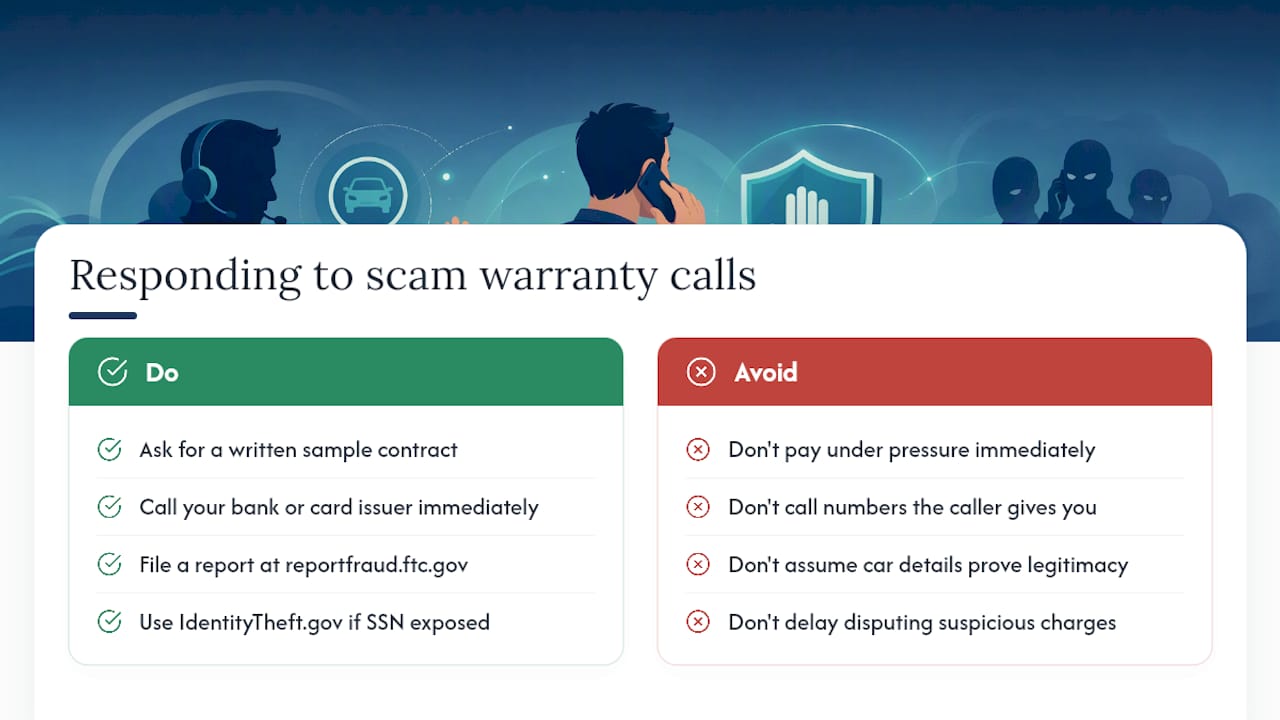
How can I tell if a warranty call is legitimate? Ask for a written sample contract, then hang up and call your manufacturer or dealer using a number you find independently, never one the caller gives you. If they resist providing written terms or pressure you to decide immediately, treat it as a scam.
The information in this article is for educational purposes only. Scam tactics change fast, and we cannot guarantee that this information is always complete or up to date.