
Telegram is a common target for social engineering, and the single safest habit you can adopt today is this: never share login codes, two-factor authentication (2FA) codes, seed phrases, or API keys with anyone who messages you first. If a stranger, a “support agent,” or even a familiar-looking admin asks for any of those, stop responding.
Treat unsolicited Telegram messages as hostile until you can verify who sent them. That’s the baseline posture security researchers recommend, and it holds up: most scams unravel the moment someone slows down and checks independently rather than reacting to the pressure inside the chat.
Do these three things right now, before reading further:
-
Turn on Telegram’s two-step verification (a password layered on top of your phone number).
-
Never send a 2FA code, seed phrase, or private key to anyone, no matter how official they sound.
-
Don’t tap links from people you don’t know, even if the message looks urgent.
Fake trading groups and “verification tax” schemes have cost individual victims large sums in a single incident. Scruteon tracks these patterns weekly so readers can recognize them before they’re the ones losing money.
Key Takeaways
Telegram scams succeed by combining manufactured urgency with requests for codes, seed phrases, or upfront fees, and pausing to verify independently defeats nearly all of them.
| Point | Details |
|---|---|
| Never share codes | 2FA codes, seed phrases, private keys, and API keys should never leave your device, no matter who asks. |
| Watch for manufactured urgency | Countdown pressure, “expiring” offers, and rushed requests are the most consistent scam tactic. |
| Follow the 3-step protection plan | Lock down your login with two-step verification, limit who can reach you, then verify before you act. |
| Check usernames closely | Look for swapped characters like lowercase “l” for capital “I” in lookalike accounts. |
| Preserve evidence if scammed | Screenshot chats and profiles, collect transaction hashes, and report to Telegram and local authorities. |
| Get a free second opinion | Scruteon’s advice page and newsletter help you check suspicious messages before responding. |
Table of Contents
Why Telegram Scams Are So Common on the Platform
Telegram wasn’t built as a hunting ground for fraud, but its design choices make one very easy to run. Anyone can create an account with just a phone number, pick a username, and start messaging strangers within minutes. There’s no verification step that confirms a person is who their profile claims to be, which means “admin,” “support,” or a familiar company name in a display name proves nothing.
Bots and channels compound the problem. A single operator can run automated bots that message thousands of people simultaneously, or broadcast to a public channel with tens of thousands of members, turning what used to be a one-on-one con into a mass campaign. Telegram’s own documentation on groups and channels confirms just how much reach a single account can command with minimal setup.

There’s also a meaningful difference between Telegram’s default cloud chats, which sync across devices and sit on Telegram’s servers, and secret chats, which are device-locked and end-to-end encrypted. Most scam conversations happen in ordinary cloud chats, not secret ones, since scammers want their messages accessible and persuasive, not hidden.
The real engine behind almost every scam, though, is manufactured urgency. “Your withdrawal expires in 10 minutes.” “This slot fills in an hour.” Scammers exploit Telegram’s speed and anonymity precisely because urgency short-circuits the instinct to verify.
Pro Tip: If a message tries to rush you into a decision, that pressure is itself the red flag. Legitimate opportunities don’t evaporate in ten minutes.
Common Telegram Scam Examples and How Each One Works
Recognizing the pattern matters more than memorizing every variation. Here are the schemes showing up most often right now.
1. Investment and Crypto Scams
Fake trading groups and “signal” channels are probably the most damaging Telegram scam category. The playbook is remarkably consistent: you’re invited into a group showing screenshots of huge profits, you deposit a small amount, and the group even lets you withdraw a little to build trust. Then you deposit more, and suddenly withdrawals are “blocked” until you pay a verification fee or tax. It’s advance-fee fraud wearing crypto clothing, and documented cases show the same sequence repeating almost word for word across different groups.
Airdrops work similarly: you’re told you qualify for free tokens, but first you need to “verify” your wallet by connecting it or sending a small deposit. Never send a seed phrase to claim anything. If you want to test an unfamiliar project, use a burner wallet with minimal funds, never your primary holdings.
2. Phishing and Code-Harvest Scams
These arrive as fake login alerts or “your account will be suspended” messages, pushing you toward a page that asks for your Telegram verification code. Anyone who has that code can take over your account instantly. Legitimate services never need your one-time code; asking for it is the scam itself.
3. Impersonation and Fake Admin or Support Accounts
You’re in a legitimate crypto or trading group, and someone with an “admin” badge or admin-adjacent username DMs you privately offering help. Real admins rarely need to slide into your direct messages, and Telegram’s group structure doesn’t require it. Cross-check any private outreach against the group’s pinned rules or the official channel before responding.
4. Fake Jobs and Giveaway Scams
A recruiter offers remote work, often “data entry” or “crypto trading assistant,” then asks for a small fee to activate your account, followed by another fee, then another. Giveaways follow the same shape: you “won,” but must pay a processing fee first. Any reward that requires payment to receive isn’t a reward.
5. Malware and Fake Apps
Some scammers push APK files or attachments disguised as trading tools, wallet apps, or “exclusive” software. Only install apps through official app stores, and never sideload an APK someone sent you in a chat. A file extension you don’t recognize is reason enough to decline.
6. Romance and Long-Con Grooming Scams
These build slowly. Weeks of conversation, shared interests, growing affection, then a sudden crisis, a medical bill, a stuck shipment, a plane ticket. A consistent tell is the push to move communication off Telegram early and, eventually, requests for money. Patience is the scammer’s tool here, which is exactly why time, not instinct, is what breaks the con.
How to Spot a Telegram Scam Before It Costs You
A few seconds of checking beats hours of damage control. Run through this before trusting any new contact, link, or channel:
-
Read the username character by character. Scammers swap a lowercase “l” for a capital “I,” or add an invisible character, to mimic a real account.
-
Remember that legitimate support will never ask for your 2FA code, seed phrase, private key, or API key. Security researchers are unambiguous on this point.
-
Type suspicious domains directly into your browser rather than clicking a link, and run unfamiliar URLs through a link-scanner before opening them.
-
Treat freshly registered or oddly shortened domains as a red flag, since scam infrastructure is often built and discarded within days.
-
Pause and verify independently through a company’s official website or a mutual contact you already trust, especially when money or credentials are involved.
Pro Tip: Bitdefender’s baseline advice is to assume any unsolicited Telegram message is hostile until proven otherwise. It sounds harsh, but it’s the mindset that stops most scams cold.
A Simple 3-Step Plan to Protect Yourself on Telegram
You don’t need deep technical knowledge to close off most attack paths. Three deliberate steps handle the bulk of it.
-
Lock down your login. Turn on two-step verification in Telegram’s privacy settings so a stolen code alone can’t grant access. Review your active sessions periodically and log out of anything you don’t recognize. A password manager helps you set a strong, unique password for that second layer.
-
Reduce who can reach you. Limit who can message you directly, hide your phone number in privacy settings, and only join groups through links from sources you already trust. Fewer strangers with access means fewer chances for someone to try.
-
Verify before you act. Never authorize a wallet connection from a link someone sent you in chat. If you’re testing a new platform, use a hardware wallet or a burner wallet with a small, disposable amount rather than your main funds.
This combined approach, locking down access, limiting exposure, and verifying independently, closes off the paths scammers rely on most. Keep sensitive financial accounts separate from the wallets or exchange logins you use for casual browsing or testing new projects, so a compromise in one place doesn’t cascade into another.
Pro Tip: Set up two-step verification tonight. It takes about two minutes and blocks the single most common account takeover method.
What to Do If You Fall for a Telegram Scam
Acting fast and methodically gives you the best shot at limiting damage and supporting any investigation.
-
Stop sending money immediately and take screenshots of the entire conversation, the scammer’s profile page, and any shared documents before they can delete or block you.
-
If you sent cryptocurrency, collect the transaction hash and destination wallet address. Blockchain explorers let you trace where funds moved next, and if they land at a known exchange, that exchange’s compliance team can sometimes act on a report if the address is linked to a KYC account.
-
Report the account to Telegram directly through the app, and file a report with local law enforcement or your country’s fraud reporting agency. If you paid by card or bank transfer, contact your bank or card issuer immediately to ask about a chargeback.
-
For larger losses involving crypto, blockchain forensics specialists can sometimes trace fund flows further than an individual can alone, though recovery isn’t guaranteed even with a full trace. Scam funnels documented in real investigations, including one where Instagram ads led victims into Telegram chats before credentials were stolen, show how far attackers plan ahead. Treat recovery as a possibility, not an expectation, and prioritize stopping further losses first.
How Scruteon Helps You Stay Ahead of Telegram Scams
Scruteon’s free newsletter covers real scams as they emerge, in plain language, one or two emails a week. No jargon, no filler, just what’s circulating and how to recognize it.
If you’re staring at a suspicious message right now and want a second opinion, Scruteon’s free advice page lets you submit screenshots or details for review before you respond to anyone.
-
Weekly-ish alerts covering romance scams, phishing, tech support fraud, and elder fraud, not just Telegram-specific schemes.
-
A direct channel to ask “is this a scam?” before money or credentials change hands.
-
Written for readers at every comfort level with technology, from teenagers to grandparents.
The Habit That Actually Stops Most Scams
Most people think scam prevention is about spotting clever fakes. It’s really about resisting urgency. Every scam type covered here, the fake trading group, the phishing prompt, the romance con, depends on getting you to act before you check. Take away the rush, and most of these schemes simply stop working.
That’s why a five-minute pause, a screenshot sent to a trusted friend, a quick search of the “admin’s” username, matters more than any technical skill. Subscribing to something that keeps feeding you current examples matters too, because scam scripts evolve constantly, and last year’s red flags aren’t always this year’s.
Get Free, Real-Time Scam Alerts From Scruteon
Instead of learning about a new Telegram scam after it’s already cost someone money, Scruteon puts the warning in your inbox before you ever encounter it. The free newsletter breaks down real, current scams, romance cons, phishing schemes, tech support fraud, in short emails you can read in under two minutes, with no subscription fee and no sales pitch attached.
If you’re already mid-conversation with someone you’re not sure about, don’t wait for the next email. Send the details to Scruteon’s free “Is This a Scam?” advice page and get a second opinion before you send money, a code, or a wallet connection to anyone. Submitting evidence takes a few minutes and could save you from a loss that isn’t recoverable.
Frequently Asked Questions
Are Telegram scams common?
Yes. Telegram’s open account creation, bot ecosystem, and large public channels make it a frequent venue for investment fraud, phishing, and impersonation, and researchers consistently flag unsolicited outreach as the biggest risk factor.
How do I identify a Telegram scam quickly?
Check the username for lookalike character swaps, notice if the message pushes urgency, and treat any request for a 2FA code, seed phrase, or upfront fee as an automatic red flag.
Can Telegram get my money back if I’m scammed?
Telegram doesn’t process payments or hold funds, so it can’t issue refunds directly. Reporting the account helps get it removed, but recovering money depends on your payment method, your bank, or, for crypto, whether funds reached a traceable exchange account.
Is Telegram itself safe to use?
Telegram’s core features, cloud chats, secret chats, two-step verification, are reasonably secure when configured properly. The risk comes almost entirely from user behavior and social engineering, not a flaw in the app itself.
Where should I report a Telegram scam?
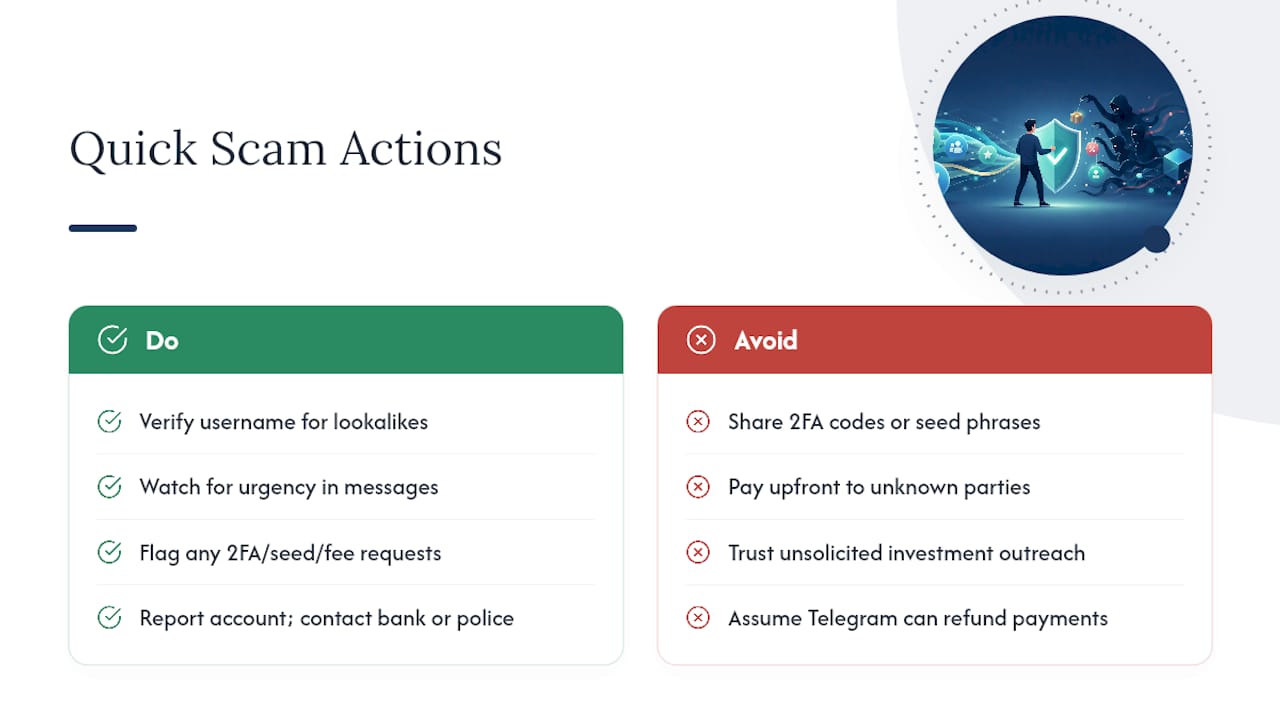
Report the account within Telegram first, then file a report with your local fraud reporting agency or law enforcement, and contact your bank or card issuer if you made a payment.
The information in this article is for educational purposes only. Scam tactics change fast, and we cannot guarantee that this information is always complete or up to date.