
Credential stuffing is an automated replay attack where criminals take username and password pairs stolen in data breaches and try them, at scale, against other websites and apps. If you reused a password anywhere, that account is at risk. For individuals: use a unique password for every account, enable multi-factor authentication (MFA), and store credentials in a password manager. For organizations: deploy bot management, enforce MFA, and integrate breached-credential monitoring into your authentication flow.
This is not a brute-force attack. Attackers are not guessing — they already have your real password from a previous breach somewhere else. That distinction matters enormously for how you defend against it.
-
Credential stuffing drives account takeover fraud, unauthorized purchases, and data theft.
-
Success rates are low (commonly estimated at 0.1%–2%), but attackers compensate with volume — millions of attempts per campaign.
-
Financial loss, reputational damage, and regulatory exposure follow a successful attack.
-
MFA is the single highest-impact control available to both individuals and organizations.
Table of Contents
How does a credential stuffing attack actually work?
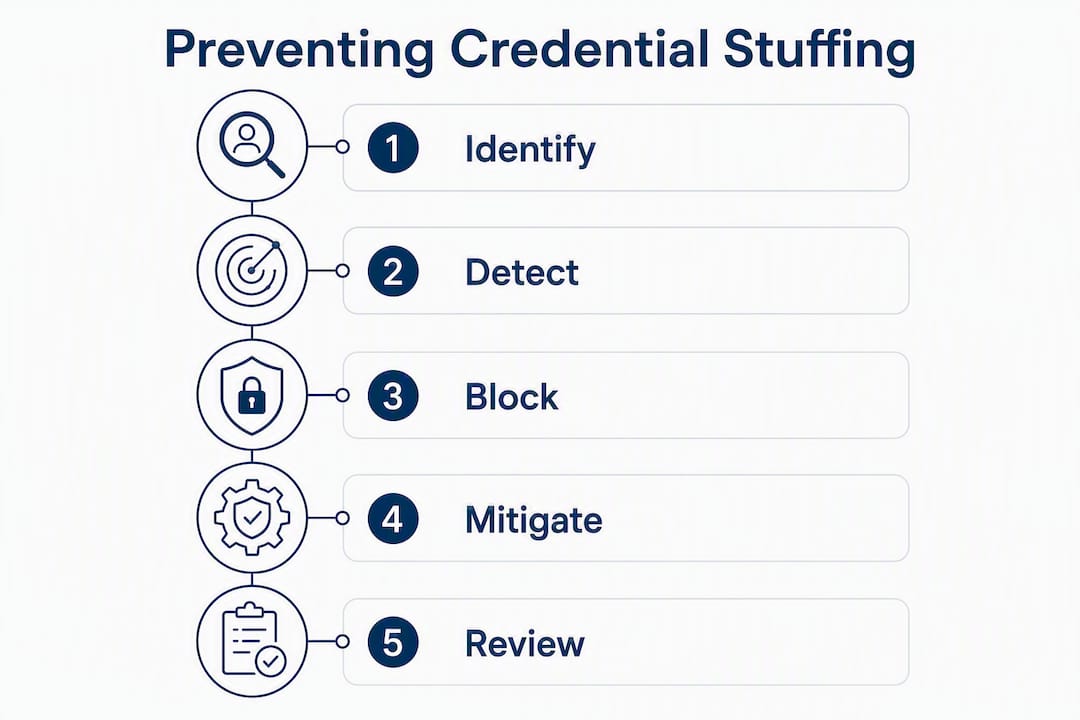
Understanding the anatomy makes detection far easier. Here is the typical sequence:
- Test. Automated toolkits — tools like Sentry MBA and OpenBullet are well-documented examples — send login POST requests to target sites at high speed. Residential proxy networks rotate source IPs to evade rate limiting and look like organic traffic.
High-volume attacks target not only consumer login pages but also APIs and federated identity tokens — endpoints where MFA is often absent and monitoring is thinner. A mobile app’s authentication API is just as valid a target as a web login form, and often less protected.
The request flow looks deceptively normal: a POST to /login with a valid-looking user agent, a standard response code (200 for success, 401 for failure), and then a session cookie on success. Nothing in a single request looks suspicious. The signal only appears in aggregate.
Why does credential stuffing keep working?
The root cause is password reuse. Most people use the same password across multiple services, often with the same email address as the username. OWASP notes that the email-as-username pattern amplifies this problem: once an attacker has your email and one password, they have a key that fits many locks.
The economics are straightforward. A 0.1%–2% success rate sounds negligible, but run 10 million credential pairs against a financial services login page and you get 10,000–200,000 compromised accounts. Each one may hold a stored payment method, a balance, or access to sensitive data. The cost of running the attack — a credential list, a proxy subscription, an automation toolkit — is measured in hundreds of dollars. The return can be orders of magnitude higher.
MFA stops the vast majority of account compromises in password-based attacks, according to Microsoft analysis cited by OWASP. That single figure explains why MFA is the non-negotiable first control.
The industry’s longer-term answer is to eliminate passwords as the primary factor entirely. FIDO2 and passkeys replace the shared-secret model with public-key cryptography tied to a device. A stolen credential list is useless against a passkey-protected account because there is no password to replay. Adoption is growing across major platforms, but most services still rely on passwords as the primary credential, which means the attack surface remains wide.
| Factor | Detail |
|---|---|
| Typical success rate | generally low success rate per campaign |
| What makes it profitable | Volume: millions of attempts per campaign |
| Primary root cause | Password reuse across services |
| Highest-impact single control | MFA (vast majority of compromises blocked) |
| Long-term structural defense | FIDO2/passkeys (no password to replay) |
How can you detect credential stuffing in your logs?
The attack is invisible at the request level. It becomes visible in patterns across requests. Here are the signals defenders should monitor:
-
Spike in failed login attempts across many distinct IP addresses, all targeting the same set of usernames or email addresses.
-
Same username targeted from many IPs in a short window — a classic distributed stuffing pattern designed to evade per-IP rate limits.
-
User-agent entropy anomalies: many requests sharing identical or suspiciously similar user-agent strings, or conversely, a flood of randomized agents that do not match real browser distributions.
-
Burst patterns: login attempts clustered in tight time windows, often with machine-regular inter-request timing rather than the irregular cadence of human users.
-
Failed-to-success chains: a sequence of 401 responses from an IP or subnet followed by a 200, especially from a low-reputation or data-center IP range.
-
Geographically inconsistent sessions: a successful login from a country or city inconsistent with the account’s established history, particularly when it follows a failed-login burst.
-
Abnormal API session creation rates: on mobile or API endpoints, a surge in token issuance or session creation that does not correlate with normal traffic patterns.
Residential proxy networks make IP-only blocking unreliable. Attackers route requests through legitimate residential IPs, so a single bad IP tells you little. Correlating device fingerprint, request timing, geolocation consistency, and user-agent entropy together gives a far stronger signal than any one indicator alone.
SIEM pattern to consider: alert when failed_login events for a single username exceed a threshold (e.g., 10 failures in 5 minutes) from more than 3 distinct source IPs, followed by a login_success event within 15 minutes from a new IP not seen in the account’s last 30 days. Tune the thresholds against your baseline before enabling automated lockout — a noisy rule that fires on legitimate users erodes trust in the alerting system.

| Signal | What it suggests | Action |
|---|---|---|
| High failed-login volume, many IPs | Distributed stuffing attempt | Trigger CAPTCHA or step-up auth |
| Same username, many IPs | Targeted account attack | Temporary account lock + user alert |
| Data-center IP on first login | Bot or proxy | Require MFA step-up |
| Geo-inconsistent success after failures | Likely compromise | Force session revocation + reset |
| Abnormal API token creation rate | API endpoint targeted | Rate-limit + investigate |
How do you prevent credential stuffing for users and organizations?
Prevention works in layers. No single control stops every attack; the goal is to raise attacker cost high enough that your platform becomes an unattractive target.
For individual users
- Enable MFA everywhere it is offered — An authenticator app (Google Authenticator, Authy, Microsoft Authenticator) is stronger than SMS, but SMS MFA still blocks the vast majority of automated attacks.
For organizations
Must do now:
-
Enforce MFA — on all user-facing login flows. Risk-based MFA (step up only on anomalous signals) reduces friction for legitimate users while blocking automated attacks.
-
Integrate breached-credential checking at authentication. Check submitted passwords against known breach databases at login and force a reset when a match is found. OWASP’s cheat sheet covers implementation options including k-anonymity APIs.
-
Deploy bot management and rate limiting that distinguishes hosting-provider traffic from residential IPs. IP-only rate limiting is insufficient against distributed attacks; bot management platforms add device fingerprinting, behavioral analysis, and reputation scoring.
Should do:
Consider for longer-term hardening:
- Disallow email addresses as usernames or offer generated usernames at account creation. OWASP recommends this as a structural reduction in attack surface.
Government-grade guidance from the Canadian Centre for Cyber Security recommends exactly this defense-in-depth approach: MFA, breached-credential monitoring, anomaly detection, and hardened authentication workflows working together.
Pro Tip: Roll out bot management controls in logging-only mode first. Measure the false-positive rate against legitimate user traffic for at least one week before switching to blocking mode. A control that locks out real customers is worse than no control at all.

What to do if credential stuffing hits your platform
Speed matters. Every minute of active compromise means more accounts affected.
- Revoke all active sessions and tokens — for affected accounts. A session cookie issued during the attack window is still valid until explicitly invalidated.
Post-incident, schedule a lessons-learned review within two weeks. Adjust rate limits, update SIEM thresholds, and verify that breached-credential monitoring is active on all login endpoints, including APIs. The OWASP Credential Stuffing Prevention Cheat Sheet and Canadian Centre for Cyber Security guidance both provide post-incident review frameworks worth bookmarking.
Real incidents that show what credential stuffing costs
-
Financial services account takeovers. The SEC has issued risk alerts on credential compromise specifically warning registered investment advisers and broker-dealers about automated credential attacks leading to unauthorized fund transfers. The lesson: financial platforms without MFA on customer accounts are primary targets, and regulatory scrutiny follows a breach.
-
Retail and loyalty program fraud — Attackers routinely target airline miles, hotel points, and retail gift card balances because these have real cash value and are often protected only by a password. Breached-credential monitoring at login would flag the compromised pairs before the attacker can drain the balance.
The UK’s National Cyber Security Centre has published direct guidance on credential stuffing tools, noting that using such tools against systems without authorization is illegal under the Computer Misuse Act — a reminder that the legal exposure runs in both directions: attackers face criminal liability, and organizations face breach notification and compliance obligations when they fail to protect accounts adequately.
Key Takeaways
Credential stuffing succeeds because password reuse is widespread, automation is cheap, and most login endpoints lack the layered controls needed to detect and block replay attacks at scale.
| Point | Details |
|---|---|
| MFA is the top priority | MFA blocks the vast majority of account compromises — enable it on every account and enforce it on every login endpoint. |
| Unique passwords stop replay attacks | A password reused across sites is the attacker’s entry point; a password manager makes unique passwords practical. |
| Detection requires pattern analysis | No single request looks suspicious; monitor for burst failures, geo-inconsistent successes, and abnormal API rates. |
| Breached-credential checks are essential | Checking submitted passwords against breach databases at login catches compromised credentials before attackers do. |
| Scruteon keeps you informed | Scruteon’s free newsletter delivers concise, timely alerts on credential stuffing trends and account takeover scams. |
Why credential stuffing should concern everyone right now
The volume of breached credentials in circulation is not shrinking. Every major data breach adds fresh pairs to the lists attackers already hold, and automation makes testing those pairs trivially cheap. What strikes me most, having followed this space closely, is how little the attack has changed in a decade — and how consistently organizations underestimate it because the success rate looks small on paper.
A 1% success rate on a million-pair list is 10,000 compromised accounts. For a mid-sized e-commerce platform, that is 10,000 customers whose payment data, purchase history, and personal details are now in someone else’s hands. The reputational cost of that notification email, the fraud reversals, the regulatory inquiry — none of that shows up in the attacker’s cost-benefit calculation, but all of it lands on the organization.
The practical emphasis should be on two things: MFA first, always, and breached-credential monitoring at the login gate. Everything else — bot management, WAF rules, device fingerprinting — is valuable, but those two controls together close the majority of the exposure. Staying current on how attackers adapt their tooling matters too, which is exactly what Scruteon’s weekly newsletter is built to deliver: short, plain-language alerts on emerging threats so you do not need to monitor security feeds yourself.
Scruteon helps you stay ahead of account takeover threats
Credential stuffing sits at the intersection of data breaches and everyday scams — the kind of threat that affects real people’s bank accounts, email inboxes, and online identities, not just enterprise security teams.

Scruteon delivers free, concise alerts on exactly these threats: account takeover tactics, phishing campaigns that harvest credentials, and the scams that follow a successful breach. No technical background required. One to two emails per week, written in plain language, covering what is happening now and what to do about it. If you suspect your account has already been compromised, you can also ask for free advice directly. Sign up at scruteon.com and get the next alert in your inbox.
Useful sources and further reading
These are the authoritative references behind this guide. Each one is worth bookmarking for implementation detail or standards compliance.
-
OWASP Credential Stuffing Prevention Cheat Sheet — The most practical technical reference for developers and security teams: layered controls, breached-credential checking, username policy guidance, and implementation notes.
-
OWASP OAT-008 Credential Stuffing — The formal threat classification from OWASP’s Automated Threats project, with detection methods and countermeasures.
-
OWASP Credential Stuffing (Community Page) — Concise attack definition and the key distinction from brute-force attacks.
-
Cloudflare: What Is Credential Stuffing? — Clear explainer on attacker economics, success rates, and bot management as a mitigation layer.
-
MITRE ATT&CK T1110.004 — Credential Stuffing — The formal technique entry covering automation tooling, proxy use, and detection opportunities within the ATT&CK framework.
-
SEC Risk Alert — Credential Compromise — Regulatory perspective on credential attacks targeting financial services firms, with compliance implications.
-
Cloud Security Alliance — 9 Best Practices for Preventing Credential Stuffing — Practitioner-oriented best practices from the CSA covering organizational controls.
This article provides general information about credential stuffing and cybersecurity defenses. It is not legal or professional security advice. Confirm current regulatory requirements and technical controls with a qualified professional or your organization’s security team.
The information in this article is for educational purposes only. Scam tactics change fast, and we cannot guarantee that this information is always complete or up to date.